We track four AI assistants for clients. Claude sends the least traffic of the four, and It is also the hardest engine to influence.
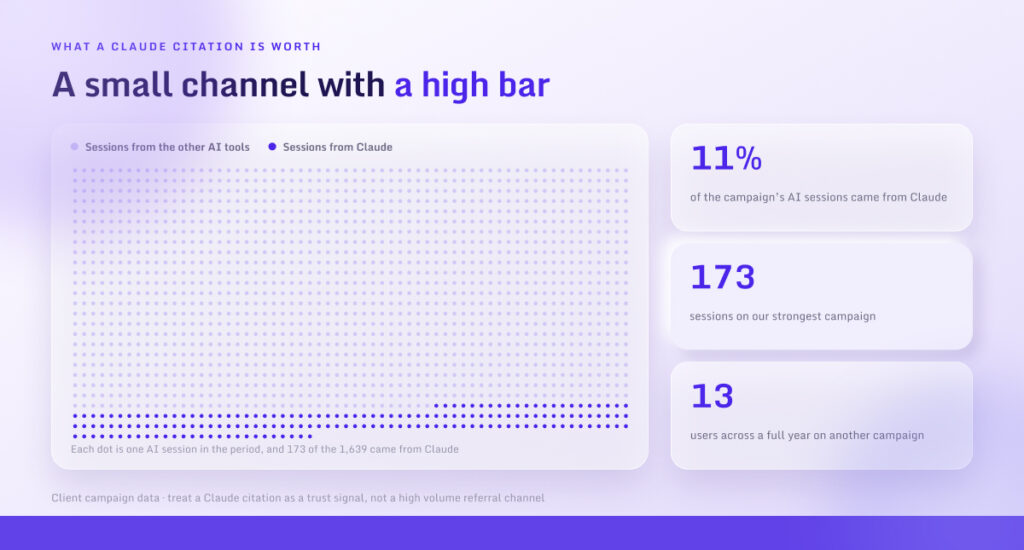
In one campaign, Claude drove 173 sessions out of 1,639 total AI visits. On another, it appeared as a new channel with just 13 users over a full year.
Those are low traffic figures, and I won’t pretend otherwise. What makes Claude worth the effort is the high bar it sets. It hedges more than other models, names fewer brands and relies heavily on verifiable sources.
When Claude finally cites your brand, it means your authority signals are strong enough that other AI tools have already picked you up. A citation from Claude serves as late proof that your strategy is working.
Here’s how we earned citations across two separate campaigns.
How Claude Picks Which Sources to Cite
Claude relies heavily on live web results rather than relying solely on stored brand memory. It also consistently attributes facts to specific sources. Both behaviors shape how you earn citations.
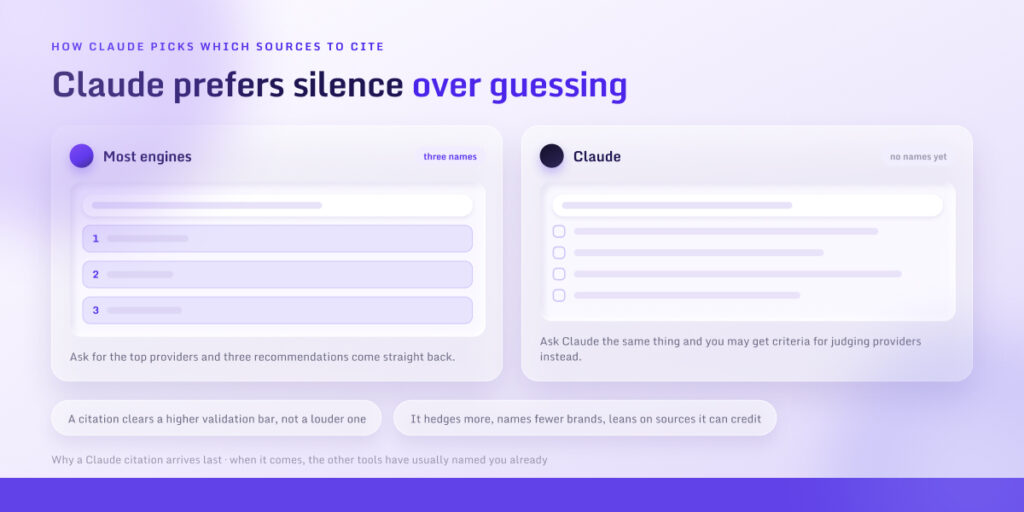
Claude prefers silence over guessing: Ask most AI engines for the top providers in a category and you receive three immediate recommendations. Ask Claude, and you might receive criteria on how to evaluate providers instead. Earning a citation requires passing a higher validation threshold rather than pushing louder marketing.
Claude rewards verifiable facts: A page that says “we are the leading provider of X” gives it nothing. A page that says “median approval time across 400 accounts was 26 hours” gives it a line it can quote and credit. We rewrote a lot of client copy on that one point.
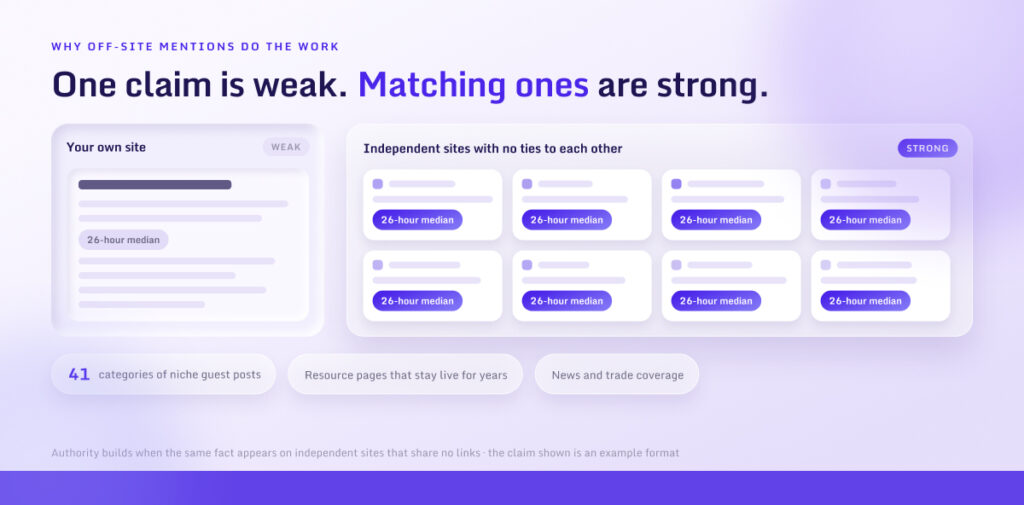
Claude cross references independent sources: A single mention on your primary site rarely suffices. Authority builds when identical facts appear across independent third party sites that share no direct links.
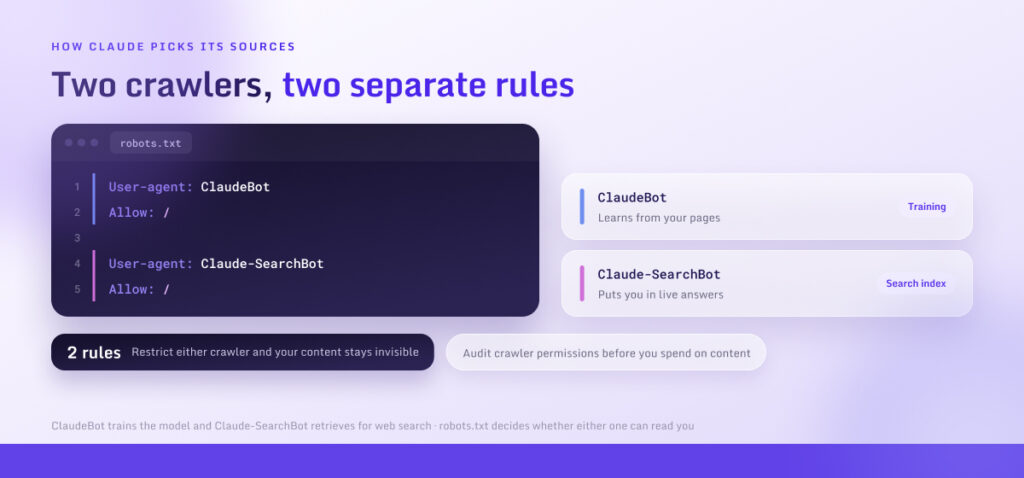
Claude has its own crawlers: Anthropic uses ClaudeBot for model training and Claude SearchBot for web search retrieval. If your robots.txt file restricts these crawlers, your content remains invisible to the model. Audit crawler permissions before allocating budget to content creation.
Case Study: How We Got Cited by Claude and Three Other AI Tools
Our client uproas.io sells agency ad accounts to media buyers who evaluate options carefully before spending. That evaluation process is exactly what buyers now assign to AI tools.
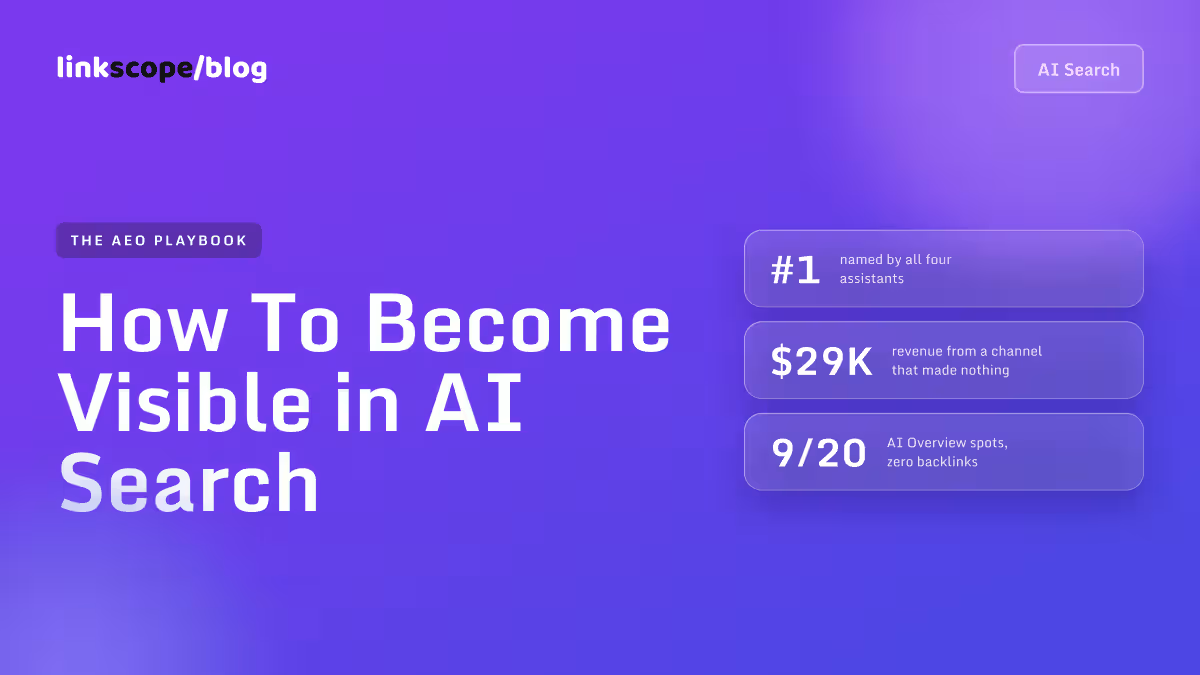
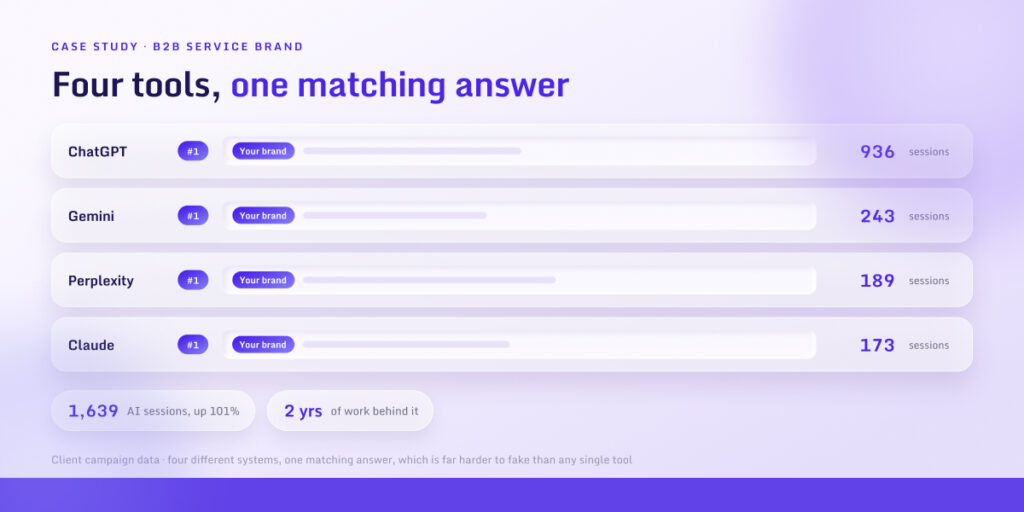
We have managed this site for two years since launch. By the end of the campaign, all four major AI engines named uproas.io first for “best agency to buy an ad account”, including Claude.
Total AI sessions reached 1,639 for the period, up 101% over the previous six months. ChatGPT generated 936 of those sessions, Gemini sent 243, Perplexity delivered 189, and Claude brought in 173.
Three specific strategies drove our visibility in Claude.
1. Data pages over keyword pages: We built pages with verifiable data including: Facebook ads statistics, Google ads statistics, and ad benchmarks. Each page provides key figures media buyers need. The stats are stated in simple terms with clear source attribution. That format allows AI tools to quote content without hedging. The Facebook ads statistics page grew 970% in Search Console and now generates a major share of total AI traffic.
2. Unified brand description across all platforms: Directories, profiles, and third party write ups all describe the brand using identical language. They state clearly what the business is, what it does, and which platforms it covers. SEO strategists call this entity consistency. When those descriptions clash, the AI tools hedges. When a dozen sources agree, the tool gives a direct recommendation.
3. Mentions on third party sites: Claude reads the live web before it answers. That means much of this work happened nowhere near the client’s own domain. Earning mentions on the sites these tools crawl is the job of digital PR link building. Most SEO plans skip it, because it does not move a rank tracker.
Four AI tools. Four different systems. One matching answer. That is the result worth chasing, and it is far harder to fake than the output of any single tool.
Schema Markup: How to Make Your Page Easy to Cite
We ran a separate campaign focused exclusively on on-page optimization for a medical cold chain packaging manufacturer. We built no new content, added zero backlinks, and performed no site rebuild.
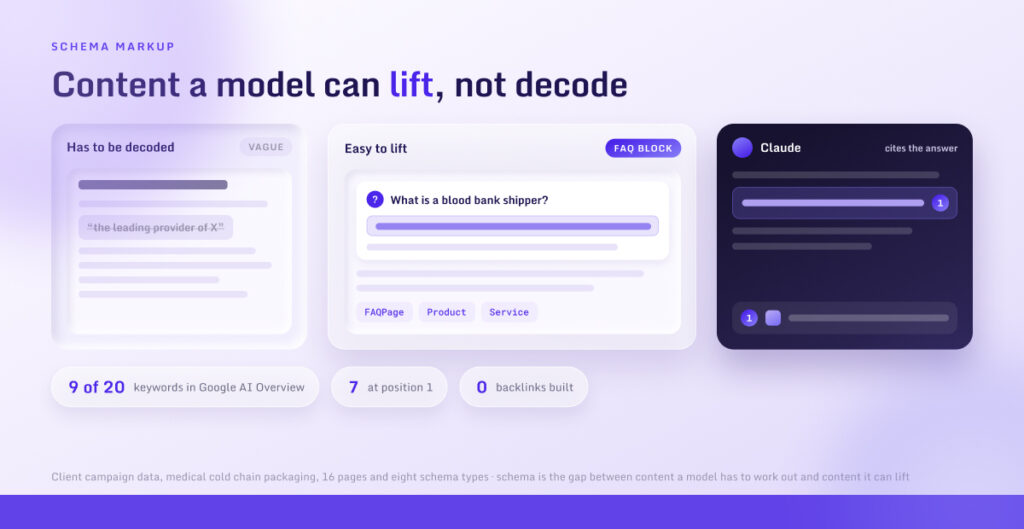
We optimized 16 pages using standard technical fixes. We added single H1 tags, put main keywords first in meta titles, set canonical tags, wrote clean alt text, and added targeted internal links by hand. We also implemented eight schema markup types based on page function, including FAQPage, Product, ProductGroup, Service, and BreadcrumbList.
The result: 9 of 20 tracked keywords started showing up in Google AI Overview. 7 keywords reached #1 position. And, one keyword jumped from outside the top 100 straight to page one. All of this occurred without building a single backlink.
This outcome applies directly to engines like Claude. When an AI model needs to answer a query like “what is a blood bank shipper”, the easiest source to cite is a page with an FAQ block formatted specifically for machine reading.
Schema is not a ranking trick. It represents the gap between content a model has to work out and content it can simply lift.
Why Claude Citations Need Off-Site Brand Mentions
Getting cited by Claude requires effort outside your own domain. You need third party sites publishing matching information.
Three placement types handle most of this heavy lifting:
Editorial posts on relevant sites: Topical relevance outperforms domain metrics by a wide margin. A DR 45 site provides a strong category signal, while a DR 78 generic site acts as noise. We secure these placements through niche guest posting across 41 categories. We rely on our SaaS publisher inventory for B2B campaigns.
Resource and reference pages: Curated resource lists on industry and university sites remain active for years. They carry far more authority than a normal guest post. However, resource page placements required extra time, but these are the ones still driving signals two years later.
News and trade coverage: Editorial mentions on regional and national outlets provides verifiable sources to AI models. Media placements are the fastest way to build authority, and the costs reflect that value.
You do not need every placement type. You simply need enough matching mentions across the web so your brand story stays consistent regardless of which source the model checks.
Our Strategy: At a Glance
Here is the whole process in one table, in the order we run it.
| Phase | What we do | Why it matters for Claude | Timeline |
|---|---|---|---|
| 1. Crawler check | Allow ClaudeBot and Claude-SearchBot, fix rendering and robots.txt | Claude reads the live web, so blocked pages never get cited | Week 1 |
| 2. Claim audit | Swap vague brand claims for facts with numbers and named sources | Claude quotes what it can check, and skips what it cannot | Week 2-4 |
| 3. Machine-readable pages | One H1, clean canonicals, FAQ blocks, and FAQPage plus Product schema | Gives the model a clean line to lift instead of a page to decode | Month 1-2 |
| 4. Data assets | Build statistics pages, benchmarks, and buying guides | These earn links in Google and citations in AI answers at the same time | Month 2-6 |
| 5. Off-site mentions | Niche guest posts, digital PR, resource pages, trade press | Claude cross-checks, so it needs sources that do not know each other | Month 2 on |
| 6. Entity consistency | Use one brand description on every profile, directory and write up | Clashing descriptions are the top reason Claude hedges | Ongoing |
| 7. Prompt testing | Ask the same set of questions each month across all four AI tools | Referral data runs low, so prompt tests are the honest read | Monthly |
Swipe sideways to see every column.
Four notes before you plan around this table.
The traffic volume is small: Claude generated 173 sessions on our best campaign. If your business model relies on Claude referral traffic paying for itself by month three, the model is flawed. Treat a Claude citation as proof that your entity work is landing, and take the clicks as a bonus.
Referral data runs low: AI tools often hide the referrer. So what you measure represents a baseline for reported sessions. A major portion of traffic marked as direct inside analytics actually originates from AI queries.
Answers are not fixed: Asking the same question in two different ways can shift brand order. We test again and again and report the pattern, not a position.
Two years is normal in a tough category: uproas.io required two years to reach top recommendations. Our jewelry client moved faster because its category was less crowded. Anyone quoting you 90 days is describing a different job.
How to Get Cited by Claude: Where to Start
Start with your own pages. Publish plain answers, verifiable figures, and FAQ blocks with matching schema. It is budget-friendly, and every step that follows relies on it.
Next, build matching brand mentions on third party sites relevant to your niche. Maintain identical brand descriptions across every single placement.
Want to review full campaign performance? Explore our detailed link building case studies. Already know which publishers you need? Use the Linkscope marketplace to filter 100K+ vetted sites by niche, traffic and DR to buy directly.
FAQs
Does Claude cite websites in its answers?
Yes. Claude links to pages when searching the web and names brands it can back up with verifiable sources.
This behavior makes checkable facts and structured data far more important than traditional keyword density.
How is Claude different from ChatGPT for AI SEO?
Claude recommends fewer brands and hedges more frequently. It leans heavily on live web sources it can credit directly.
While ChatGPT often provides names based on general training data, Claude requires external sources to point to before making a recommendation.
How much traffic does Claude send?
Volume remains lower than competing AI tools. On our strongest campaign, Claude generated 173 out of 1,639 total AI sessions, representing roughly 11% of traffic.
Treat Claude visibility as a primary trust signal rather than a high volume referral channel.
Do backlinks help you get cited by Claude?
Yes, though the primary mechanism has evolved. Backlinks still pass domain authority, but for AI citations, the brand itself performs much of the heavy lifting by reinforcing entity identity.
A relevant brand mention without a hyperlinked URL still carries significant weight.
Should I block ClaudeBot in robots.txt?
Only if you intend to stay out of Claude’s responses entirely. Anthropic uses ClaudeBot for model training and Claude SearchBot for live search retrieval.
Blocking either crawler hides your content from search results, so audit your robots file before analyzing content performance.
How do I track Claude traffic in GA4?
Monitor claude.ai within your referral traffic reports. You should also track direct traffic spikes that align with campaign efforts, as many AI referrals strip tracking data.
Finally, test target prompts manually every month to identify citations that generate visibility without registering direct clicks.