If you are selling links to clients, you need to price them for a good business.
Most agencies get this wrong and charge too close to the cost.
They worry clients will balk. They undercut themselves before the conversation even starts.
The problem is not your pricing. The problem is you are guessing.
You do not know what other agencies charge. You do not see their margins. You think 20% markup sounds fair. Let me tell you It does not.
Most agencies mark up LinkScope links 150 to 200 percent. Their clients pay without pushback.
Today, we will show you the exact markup formulas, real agency examples with numbers, the pricing models that work, what to charge, how to present it, and what mistakes to avoid
Understanding Your Link Building Business Cost Structure
You need to know what you actually pay before you can mark anything up.
LinkScope pricing is simple. You pay based on domain rating. Higher authority costs more.
Here is the breakdown:
| Domain Rating (DR) | Average Link Cost |
|---|---|
| 10-20 | $20 – $50 |
| 20-40 | $50 – $100 |
| 40-60 | $100 – $150 |
| 60-70 | $150 – $200 |
| 70-80 | $200 – $250 |
| 80+ | $250+ |
Disclaimer: These are average link costs. Actual prices may vary based on quality, competition, and our marketplace data. Use this as a general guide.
In our experience, we have seen that most agencies spend between $20 and $300 per link on average when mixing tiers.
Volume discounts kick in at $5,000 per month. You get dedicated account management. Custom pricing on bulk orders. Better margins at scale.
Also, your time is a hidden cost. Even with LinkScope handling delivery, you still spend 30 to 60 minutes per client monthly.
You will be planning links, reviewing placements, and updating clients.
If your time is worth $150 to $200 per hour, that is $75 to $200 in labor per client per month.
Factor that into your pricing, or you are working for free.
The 3 Pricing Models That Work
Most agencies use one of these three models. Pick the one that fits your client type.
Model 1: Tiered Package Pricing
You create three options. Clients pick based on budget and scale.
| Package | Links per Month |
DR Requirement |
Price per Link |
Total Price |
Payment to LinkScope |
Margin |
|---|---|---|---|---|---|---|
| Bronze | 5 | DR40+ | $150 | $750 | $200 | $550 |
| Silver | 10 | DR50+ | $200 | $2,000 | $500 | $1,500 |
| Gold | 20 | DR60+ | $250 | $5,000 | $1,200 | $3,800 |
Most clients will pick Silver. You designed it that way. The margin scales with volume.
Model 2: Retainer-Based Pricing
You bundle links into your monthly SEO retainer. The client does not see line items.
For example, you charge $3,000 per month for SEO services.
You allocate $1200 of that retainer to link building. You spend $600 on LinkScope links. You keep $600.
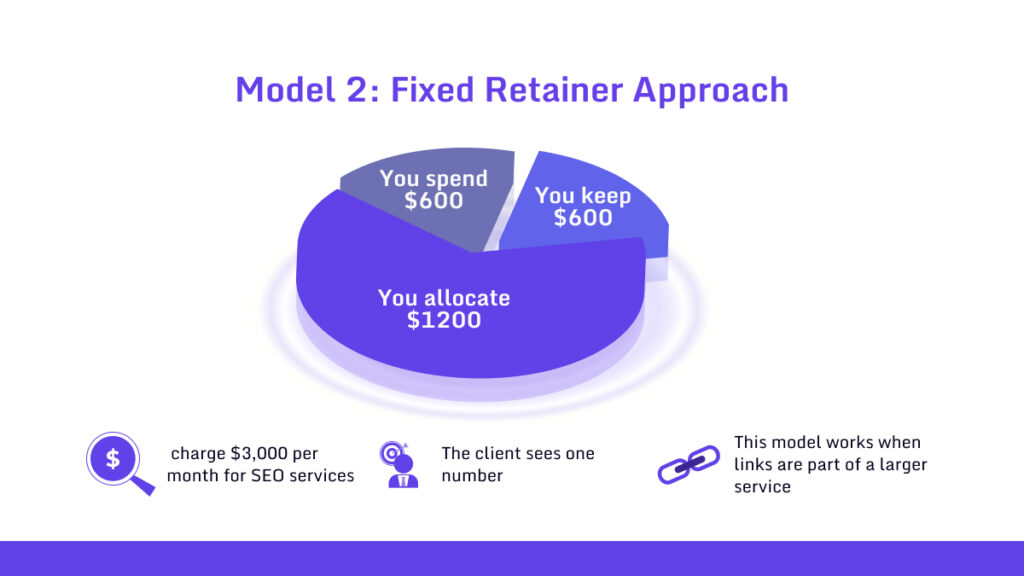
The client sees one number. They focus on results. They do not scrutinize per-link costs.
This model works when links are part of a larger service.
The client pays for outcomes. You control the budget internally.
Model 3: Per-Link Custom Pricing
You price based on the client’s industry and budget. Different verticals expect different costs.
| Client Type | Markup (%) | Notes |
|---|---|---|
| Tech and SaaS clients | 180–200 | Bigger budgets; value authority |
| Local service businesses | 130–170 | Smaller budgets; still profitable |
| E-commerce | 160–180 | Middle ground; volume often makes up the difference |
You adjust per client. You are not locked into one price across your roster.
Few Agency Examples
Here are three agencies with three different business models.
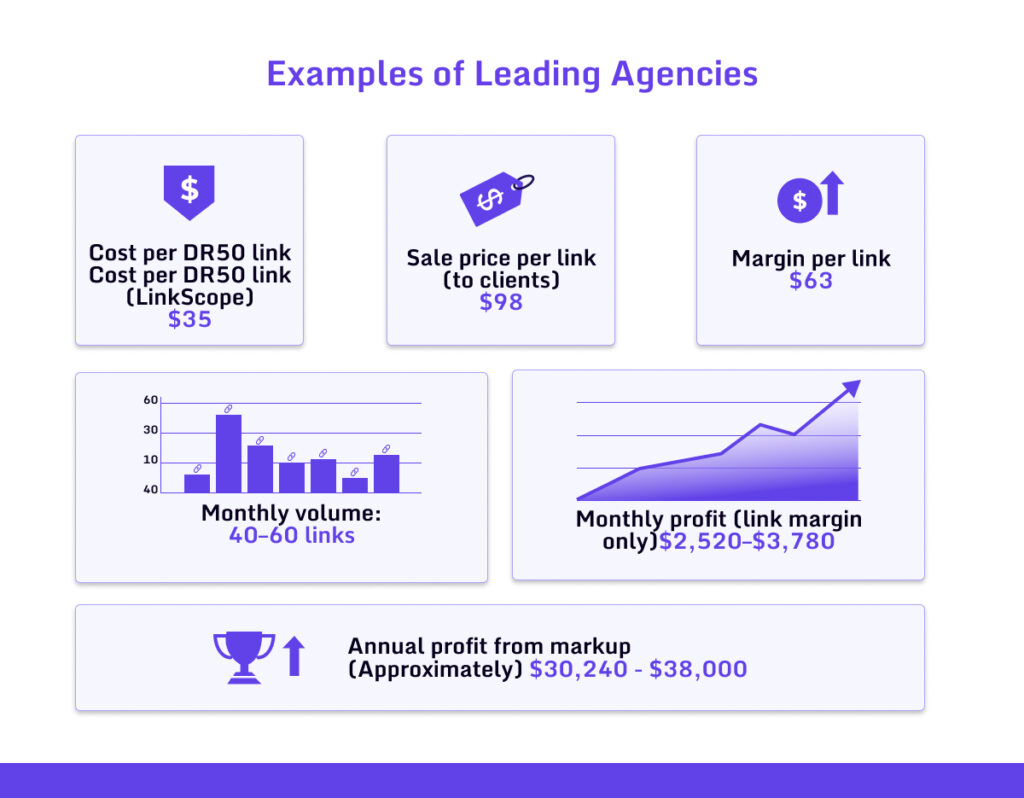
Agency A: 3-person team, 180% average markup
They bought DR50 links at $30 – $40 on LinkScope and sold them to clients at $98.
Monthly volume sits between 40 and 60 links. Monthly profit from link margins alone runs $2,520 to $3,780.
Annual profit from LinkScope markup was around $38,000. That covers one full-time employee.
Major achievements:
- ➜ Average markup was 180%
- ➜ Annual profit (Approximately) was $38,000
- ➜ Easiest transaction they had
- ➜ They did not hire anyone new to get that margin.
Agency B: Solo consultant, 210% markup
She positions her business as a premium boutique. Her clients expect higher prices.
She bought DR60 – DR 80 links at $70. She sells them at $200 – $240.
Her monthly volume was small, between 10 and 15 links. But the growth was amazing.
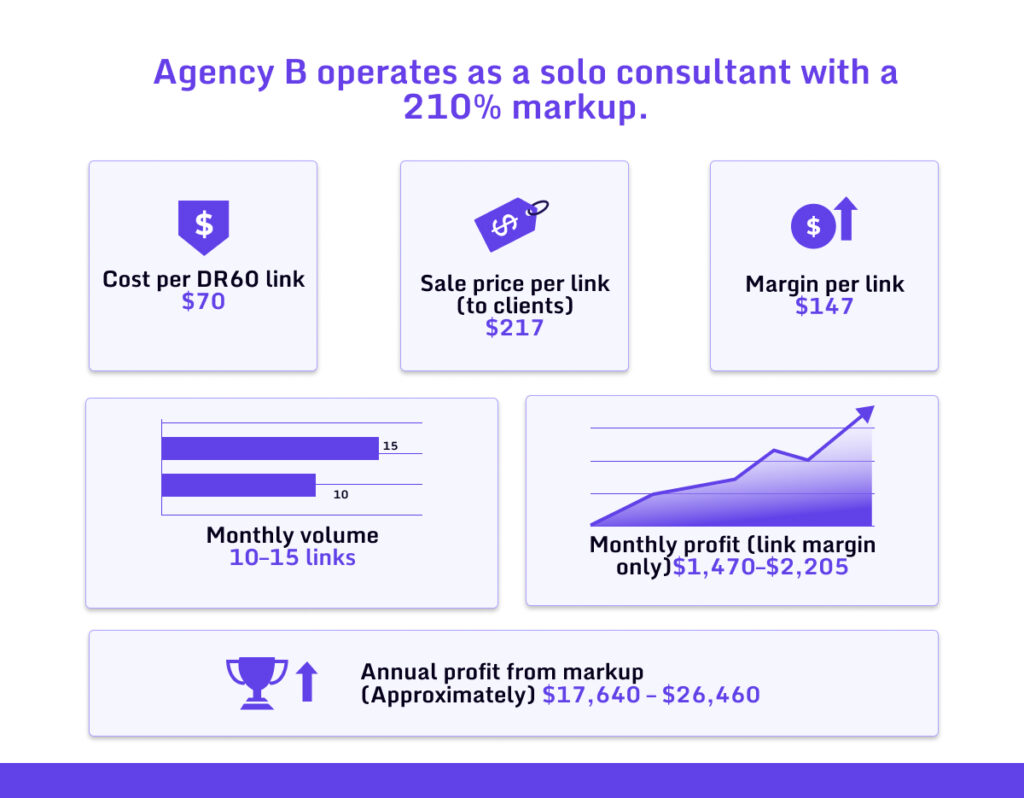
Her overhead stays low. Her margins stay high. She does not need volume to make this work.
Major achievements:
- Average markup was 210%
- Annual profit (Approximately) was $26,460
- We got this compliment that if it wasn’t for Linkscope, she alone couldn’t have done it.
Agency C: 12-person agency, 165% markup
They run the business on a volume game. Though the margin was lower, they still got 165% markup.
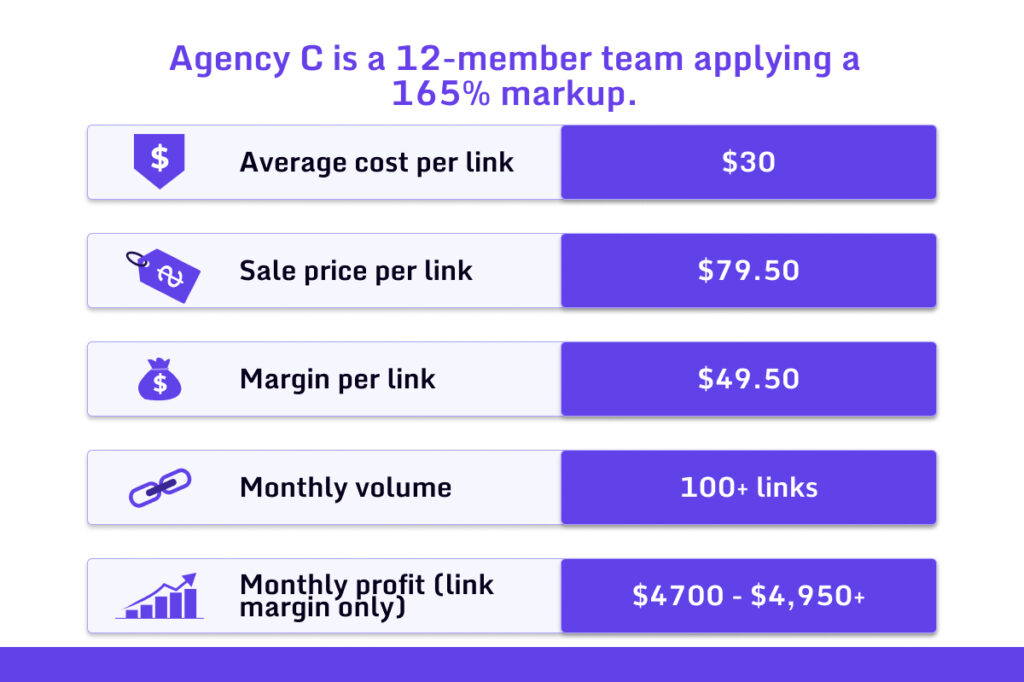
They scale with volume. The margin per link is smaller, but the total profit is larger. They move fast and keep clients happy with delivery speed.
Major achievements:
- Average markup was 165%
- Annual profit (Approximately) was $59,400
How to Present Pricing to Clients
How you frame the price matters more than the number itself.
Most agencies lose margin because they present links as a commodity. They list costs. They invite comparison. They make clients think about the expense instead of the result.
Stop doing that.
Here are three ways to present pricing without killing your margin.
Bundle and Hide
Do not itemize link costs in your proposal.
Clients do not need to see line items. They need to see what they get.
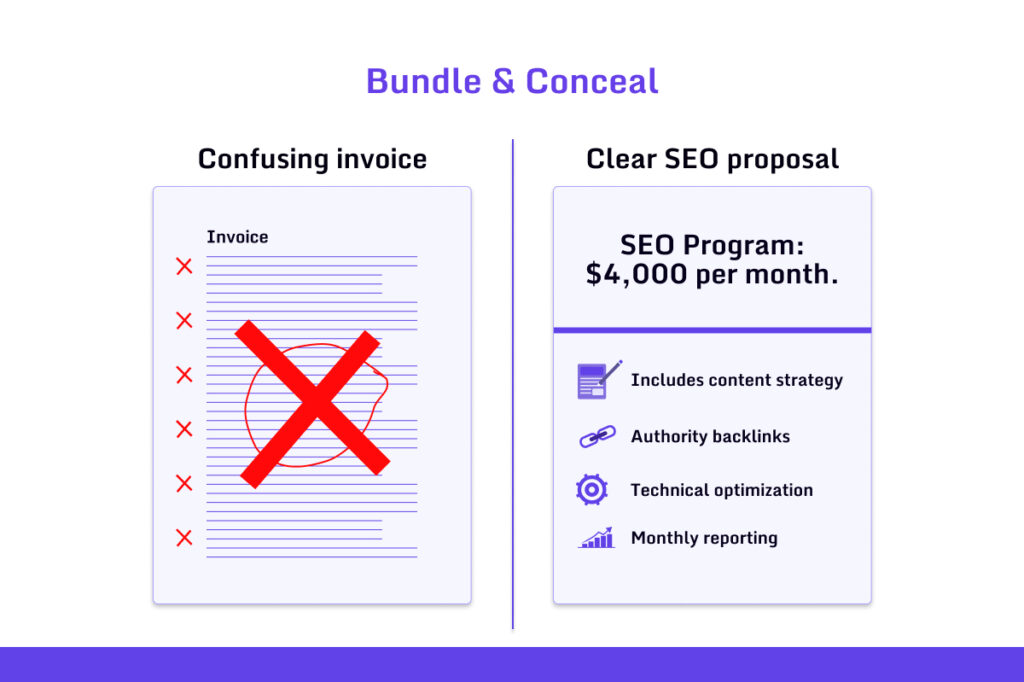
Your retainer looks like this: “SEO Program: $4,000 per month. Includes content strategy, authority backlinks, technical optimization, and monthly reporting.”
The client sees a complete system. They focus on outcomes. They do not calculate your cost per link.
When links are buried in a broader service, clients stop scrutinizing individual prices. They evaluate the total package. That is where you want the conversation.
This works best for agencies running full-service SEO. If you only sell links, use the next strategy.
Value-Based Pricing
Lead with quality. Not cost.
Your proposal says: “DR70 authority backlink from finance publisher: $300.”
You emphasize the domain rating. You name the industry. You make it sound exclusive.
Then you show alternatives. Authority Builders charges $500 to $800 for similar links. Other providers charge $400 to $600. Your price suddenly looks fair.
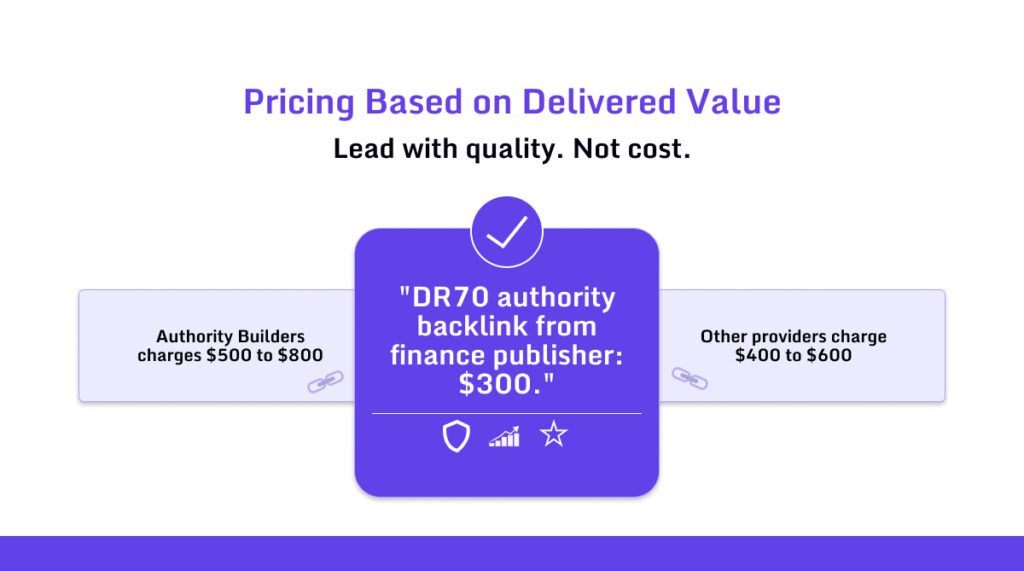
Clients compare you to the market. Not to your cost. That is the entire game.
This works when you sell links as a standalone service. The client understands they are buying premium placements. They expect to pay for quality.
ROI Framing
Make the client do math that favors you.
You say: “This DR60 link could drive 50 clicks per month. At a 2% conversion rate with a $2,000 customer value, that is $2,000 in potential monthly revenue from one link.”

Or you say: “One ranking improvement from position 6 to position 3 typically adds 200 monthly visitors. That is 2,400 visitors per year from this campaign.”
You are not lying. You are showing possibilities.. Clients start thinking about upside instead of cost.
The link stops being a $200 expense. It becomes a revenue driver. That shift changes the negotiation completely.
This works best with clients who understand their unit economics. SaaS companies. E-commerce brands. Anyone who tracks customer lifetime value.
Pick the strategy that fits your client type. Use it consistently. Your margins will stop shrinking.
Common Pricing Mistakes to Avoid
Most agencies lose money on links without realizing it. Here are the mistakes that kill margins.
Charging too close to your cost
If you buy a link for $50 and sell it for $75, you made $25. That sounds fine until you factor in your time.
You spent an hour on client calls. Another hour reviewing placements. Another handling questions. Your time costs $150 per hour minimum.
You just lost money on that client.
Under 100% markup means you are working for free. Most profitable agencies start at 150% and go up from there.
Showing clients LinkScope invoices
This breaks your white label setup. The client sees your cost. They know your margin. Your pricing power disappears.
Keep invoices internal. Your client gets a clean invoice from your agency. They never see LinkScope branding or pricing.
If a client asks for proof of placement, send them the live link. Send them a screenshot of the published post. Do not send them vendor receipts.
Competing on price instead of value
When a client says your links are expensive, weak agencies drop their price. Strong agencies explain the value.
You are not selling links. You are selling rankings. Traffic. Revenue potential.
A $200 link that ranks a page is worth thousands in traffic value. Frame it that way.
If you compete on price, you attract clients who only care about price. Those clients leave for anyone cheaper.
Not adjusting for client size and budget
A local plumber and a SaaS company should not pay the same rate. The SaaS company has a bigger budget. They understand the value. They expect to pay more.
Charge based on what the client can afford and what the result is worth to them. A link that drives enterprise leads is worth more than a link that drives local service calls.
Adjust your markup by client type. Do not use one price for everyone.
Forgetting to account for your time
You are not just reselling links. You are managing strategy. Reviewing placements. Handling client questions. Reporting results.
That time has value. If you spend five hours per month managing a client’s links, that is $750 of your time at $150 per hour.
Your markup needs to cover that time. Otherwise, you are subsidizing the client with free labor.
Factor your time into every pricing decision. If a client needs heavy hand-holding, charge more.
The Pricing Psychology Advantage
Your pricing structure affects what clients choose.
Most people do not pick the cheapest option. They do not pick the most expensive either. They pick the middle.
This is not a guess. This is how buying decisions work.
Start high. Show the premium option first. When clients see a $500 per link package, $200 looks reasonable. If you lead with $100, they anchor there. Everything else feels expensive.
Use odd numbers.
Price is $297 instead of $300. The difference is three dollars. The psychological gap is larger. Odd pricing signals value optimization. Even pricing signals arbitrary rounding.
Build three tiers. Bronze, Silver, Gold. Starter, Growth, Premium. The names do not matter. The structure does. Design your middle tier with the best margin. Most clients pick it. They avoid looking cheap.
They avoid overspending. You profit most from the majority choice.
Offer annual discounts. Clients who pay upfront get 10 to 15 percent off. You get cash now. They stay locked in for twelve months. This improves your cash flow and reduces churn. Both matter more than the discount cost.
These tactics are not tricks. They are defaults in how people evaluate price and value.
Markup Calculation
You need to see your numbers.
Here is how to calculate your markup.
Start with what you pay LinkScope. Pick your desired margin. The math shows what to charge.

Basic Formula
Client price = LinkScope cost × (1 + markup percentage)
For example, you buy a DR50 link for $35, and you want 180% markup.
- Client price = $35 × 2.8 = $98
- Your profit per link = $63
Monthly Profit Scenarios
Let’s see the profits for both 10 and 50 links.
| Links per Month | Cost per Link | Client Price per Link | Monthly Revenue | Monthly Cost | Monthly Profit |
|---|---|---|---|---|---|
| 10 | $35 | $98 | $980 | $350 | $630 |
| 50 | $35 | $98 | $4,900 | $1,750 | $3,150 |
Volume Impact
At 10 links monthly, you clear $7,560 per year. At 50 links monthly, you clear $37,800 per year.
Your Turn (Simply)
- ➜ Take your average LinkScope cost per link.
- ➜ Multiply by 2.5 for a conservative 150% markup. That is your starting client price.
- ➜ Track it for three months.
- ➜ If no one pushes back, raise it.
Welcome to Linkscope: Your New Backlink Buddy
Most agencies mark up LinkScope links 150 to 200 percent.
Their clients pay. No complaints. No pushback.
Your margin strategy is your profit strategy. If you charge too close to cost, you work harder for less. If you price right, you scale without hiring.
Start at 150 percent. Test it with three clients. When they pay without question, you know you can go higher.
As you prove value, your pricing power grows. Agencies that deliver results charge more. Clients accept it.
LinkScope gives you the infrastructure. You set the margin. You keep the difference.