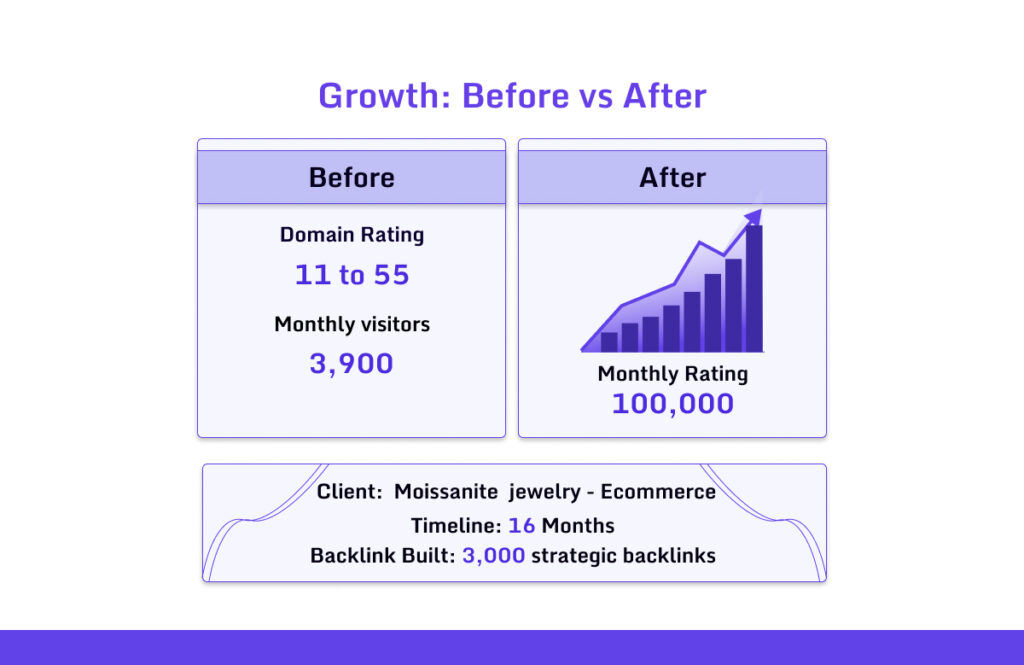
In just 16 months, we took a jewelry e-commerce site from 3,900 monthly visitors to over 100,000 using 3,000 strategic backlinks. Their Domain Rating skyrocketed from 11 to 55, and organic traffic and visibility reached all-time highs. Check out our Moissanite jewelry case study for more details.
When it comes to ranking your page at the top, the role of the number of backlinks is a nuanced discussion, and there is no black-and-white answer for that. On the contrary, the question isn’t how many backlinks you need; it’s which backlinks will move your needle. After helping 100+ clients across industries, from local services to enterprise SaaS achieve similar transformations, I’ve cracked the code on exactly how to calculate your magic number.
Quick Answer: What You Actually Need
For most sites targeting competitive keywords:
- ➜ Local Business (Plumber, Dentist, Attorney): 100 to 150 quality local referring domains
- ➜ E-commerce Store: 500 to 3,000+ backlinks distributed domain-wide
- ➜ B2B SaaS Company: 2,500+ referring domains for aggressive growth
- ➜ Professional Services (Agency, Consultancy): 100 to 250 high-relevance backlinks
- ➜ Healthcare / Legal / Financial (YMYL): 300 to 1,000+ authoritative backlinks
Critical caveat: These numbers assume strong content, solid technical SEO, and most importantly, the right kind of links. One strategic link from a DR 90+ publication can move rankings faster than 100 blog comment links. Always.
Read on to understand why these numbers matter, how to calculate your exact target, and the frameworks that separate winners from everyone stuck on page 2.
The Confession Nobody Else Will Make
Let me start with a confession: I used to hate this question.
Why? Because for the first five years of my SEO career, I’d confidently tell clients “you need about 50 to 100 backlinks” and watch their rankings either skyrocket or do nothing. Radio silence. No movement at all.
It drove me crazy until I realized something that changed everything.
I was asking the wrong question entirely.
See, asking “how many backlinks do I need?” is like asking “how much money do I need to be happy?” The answer is always, it depends on what you’re trying to buy.
After analyzing over 1000+ websites across 35 different industries, building links for Fortune 500 companies and scrappy startups alike, I’ve finally cracked the code, and I’m going to share everything with you today: the frameworks, the calculations, the real numbers, and most importantly, the truth nobody else is telling you.
The Answer Nobody Wants to Hear (But Everyone Needs)

Once, we worked with an e-commerce jewelry client competing in one of the most saturated niches online. Their competitors had established brands, influencer partnerships, and backlinks from major publications.
When they came to us, their situation was dire.
Starting Point:
- ➜ Domain Rating: 11
- ➜ Monthly Traffic: 3,900 visitors
- ➜ Thin backlink profile with mostly low-quality links
- ➜ No keyword dominance for product or comparison terms
Meanwhile, their top competitors had:
- ➜ DR 60-80+ domains
- ➜ Links from fashion magazines, lifestyle blogs, and bridal publications
- ➜ Years of accumulated authority
- ➜ Thousands of established backlinks
That’s when it hit me: We’re looking at it all wrong.
It’s not “how many backlinks do you need?” It’s “how many of the RIGHT backlinks do you need?”
We built 3,000+ backlinks over 16 months using Linkscope’s marketplace, a strategic mix of DR 70-90 authority placements, niche-relevant contextual links, and foundational citations.The result?
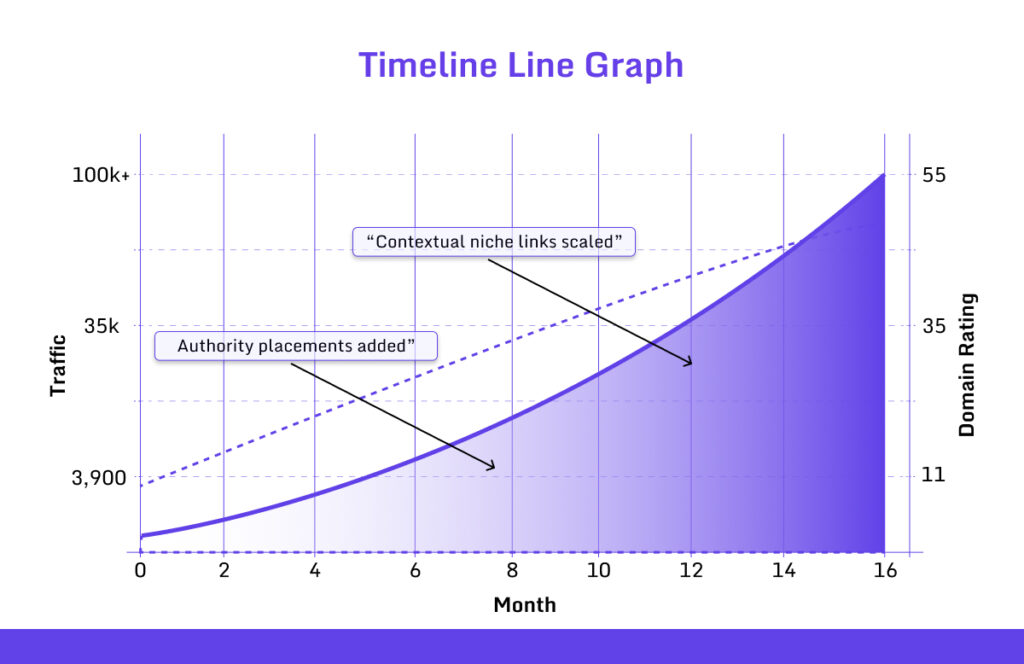
- ➜ Traffic exploded from 3,900 to 100,000+ monthly visitors (+2,400%)
- ➜ Domain Rating jumped from 11 to 55 (+400%)
- ➜ Ranked for 90+ competitive keywords
- ➜ Organic revenue hit records, reducing ad spend by 70%
Key Takeaway: Quality trumps quantity in every scenario. Google’s algorithm in 2026 heavily weights the reputation and relevance of linking sites, not just the raw count.
The Uncomfortable Truth About Backlinks in 2026
According to the latest research:
- ➜ 96.55% of all pages get zero search traffic from Google (mainly due to lack of quality backlinks)
- ➜ Backlinko analyzed 11.8 million search results and found that the #1 result has 3.8x more backlinks than positions #2–#10
- ➜ But here’s the kicker: 71.1% of professionals believe ranking through content alone. without link building is possible (Editorial).
How can all three be true?
Because Google’s algorithm has evolved. Dramatically.
Think of it like dating in the 1950s vs. dating now. Back then, all that mattered was whether you had a stable job (backlinks). Now? Your personality matters (content quality), your social proof matters (brand mentions), your reputation matters (E-E-A-T signals), and yes, your job still matters (backlinks), but it’s just one piece of the puzzle.
Backlinks still account for approximately 30% of Google’s ranking factors—that’s massive. But the type and quality of those backlinks now matters more than ever.
Let me show you exactly how this works in 2026.
How Many Backlinks by Niche? (The Real Numbers)
After working with clients across 35+ industries, here’s what I’ve learned about how many backlinks you REALLY need:
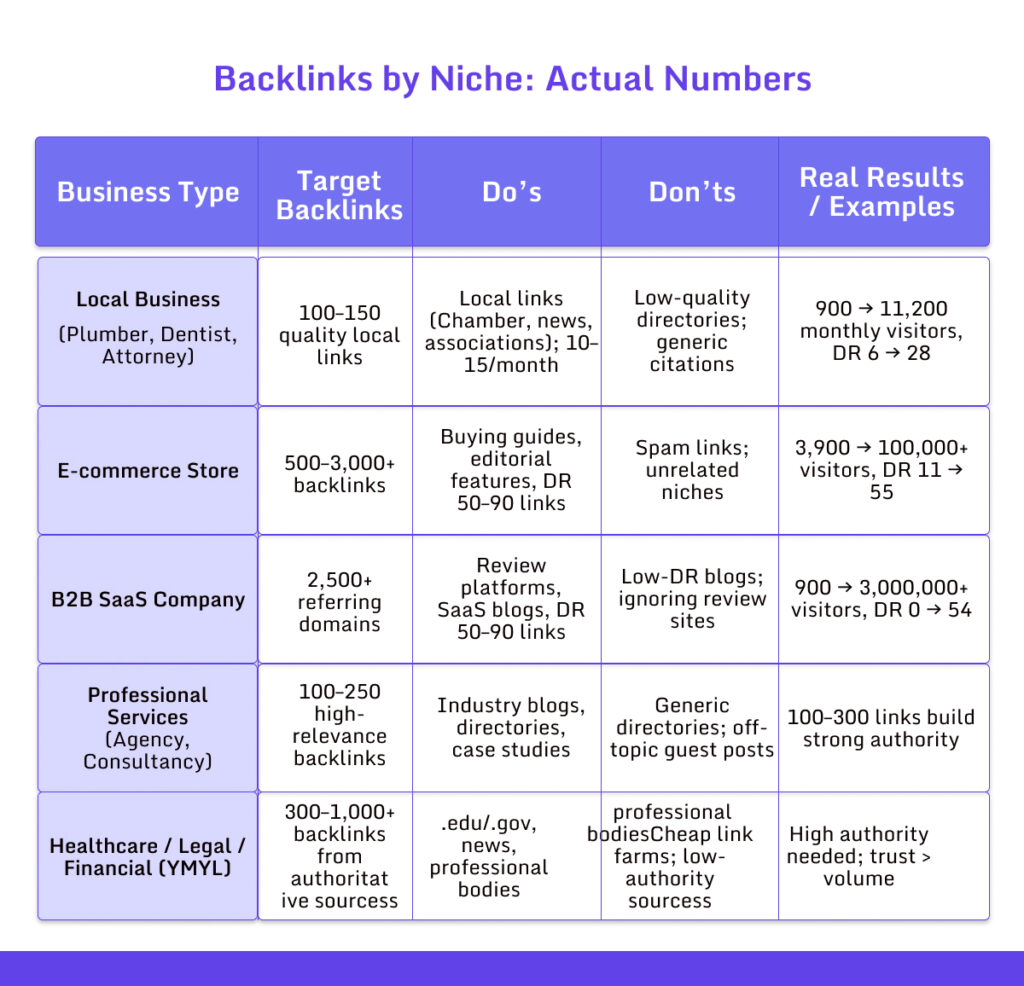
| Business Type | Target Backlinks | Do’s | Don’ts |
|---|---|---|---|
|
Local Business (Plumber, Dentist, Attorney) |
100–150 quality local links Based on: Los Angeles tree service client that achieved 1,144% traffic growth with 120+ backlinks in 12 months, climbing from DR 6 to DR 28. Real Results: LA tree service client went from 900 – 11,200 monthly visitors (+1,144%) with this exact approach. |
|
|
| E-commerce Store |
500–3,000+ backlinks to the domain, distributed across homepage, category pages, key products, and content Based on: moissanite jewelry client built 3,000+ backlinks in 16 months. Men’s jewelry brand built 740+ in 12 months, both achieving explosive growth. Real Results: • ➜ Moissanite jewelry brand: 3,900 to 100,000+ visitors (+2,400%), DR from 11 to 55 • ➜ men’s jewelry brand: 30K to 740K visitors (+2,366%), DR 23 to 61 |
|
|
| B2B SaaS Company |
2,500+ referring domains for aggressive growth Based on: Socialplug client went from DR 0 to DR 54 with 2,500+ backlinks in 24 months, achieving 3,000,000+ monthly visitors. Real Results: Socialplug achieved 330,000% traffic growth (900 – 3,000,000+ monthly visitors), reducing paid ad dependency by over 85%. |
|
|
|
Professional Services (Agency, Consultancy) |
100–250 high-relevance backlinks Based on: Competitor guidelines for B2B and service businesses commonly cite 100-300 editorial or high-quality links as enough to build strong authority, depending on competition. |
|
|
|
Healthcare / Legal / Financial (YMYL) |
300–1,000+ backlinks from authoritative sources Based on: High-stakes YMYL niches are consistently described as needing the highest authority and volume, with 300-1,000+ links often emphasizing .gov/.edu and major trusted sites. |
|
|
Key Takeaway: Use these benchmarks as starting points, not absolutes. Your exact number depends on keyword difficulty, competitor strength, and your domain’s existing authority.
Free Backlink Calculator: Find Your Target in 30 Seconds
Skip the manual calculations and get a quick projection instead. Use our free tool below. Add your competitor’s referring domains and yours, and we’ll display the target.
Backlink Estimation Calculator
Find out how many backlinks you’ll truly require to rank for your keyword — considering keyword difficulty and your website’s domain rating.
📊 Formula used: (KD × 1.3) + ((100 − DR) × 0.4)
This model assumes proportional correlation between link velocity, keyword difficulty, and domain authority.
Example Calculation:
Input: Competitor has 150 RD, you have 30 RD, rank gap = 1
Target: 150 × 1.20 = 180 RD
Gap: 180 − 30 = 150 referring domains needed
Timeline: At 12 RD/month = 12.5 months of consistent link building
Ready to Build Quality Backlinks That Actually Move the Needle?
Now that you know your backlink target, it’s time to turn that number into reality. LinkScope helps you discover high-quality link building opportunities, analyze competitor backlinks, and execute strategic outreach campaigns that drive real rankings.
Stop guessing. Start building links that matter.
Get Started with LinkScope →The Quality vs. Quantity Equation (Finally Explained Right)
Case Study: The Single Link That Changed Everything
To understand the real-world impact of link quality, let me share one of our most dramatic results.
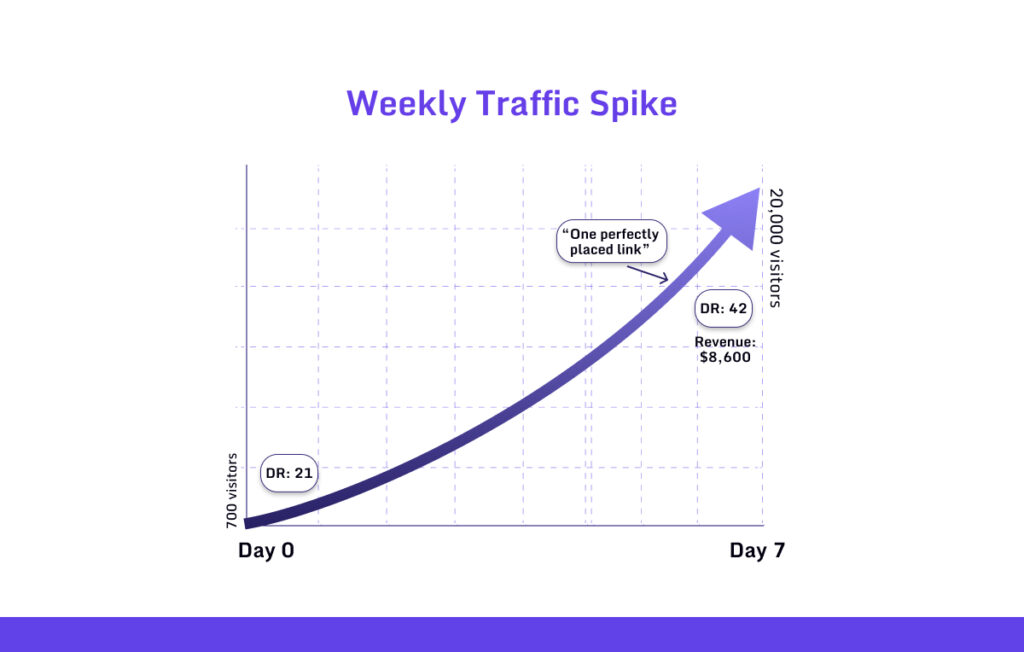
A client came to us frustrated with slow, manual link building. They had DR 21 and were getting 700 monthly visitors. They needed a breakthrough fast.
Within seven days of placing a single, expertly chosen backlink through Linkscope’s marketplace, their results were staggering:
The Strategic Approach: One Perfect Placement
- ➜ Precision site filtering: 100k+ monthly traffic, proven keyword rankings, minimum 2-year domain age, tight niche relevance
- ➜ High-intent topic selection targeting buyer-intent keywords
- ➜ Pillar-level content with original visuals and semantic SEO
- ➜ Smart on-page optimization with perfect anchor text and LSI keywords
The Results:
- ➜ 20,000 visitors in seven days (from 700) = 2,758% increase
- ➜ Traffic value estimated at $5,000
- ➜ Ranked for five high-difficulty keywords within a week
- ➜ Domain Rating jumped from 21 to 42 (+100%)
- ➜ Revenue: $8,600 in the first week
This was a parasite SEO strategy focusing on one perfect placement on a high-authority domain—proving that strategic link placement can deliver explosive results.
The Verdict: Strategic Quality Over Blind Quantity
This data proves that a single high-tier link—when placed strategically on the right platform—can outweigh dozens or even hundreds of low-quality links.
This is why most winning campaigns rely on a small set of proven link building strategies that prioritize authority, relevance, and contextual placement instead of chasing raw link counts.
According to industry research, one DR 90+ editorial link from a major publication can offset 50-100 low-quality links in competitive SERPs.
Rule of Thumb: One strategically placed DR 90+ link with 100k+ monthly traffic beats 50-100 random blog comment links—I’ve seen it happen dozens of times.
Key Takeaway: Stop chasing link counts. Start chasing link authority and strategic placement.
The Relevance Scaling Factor
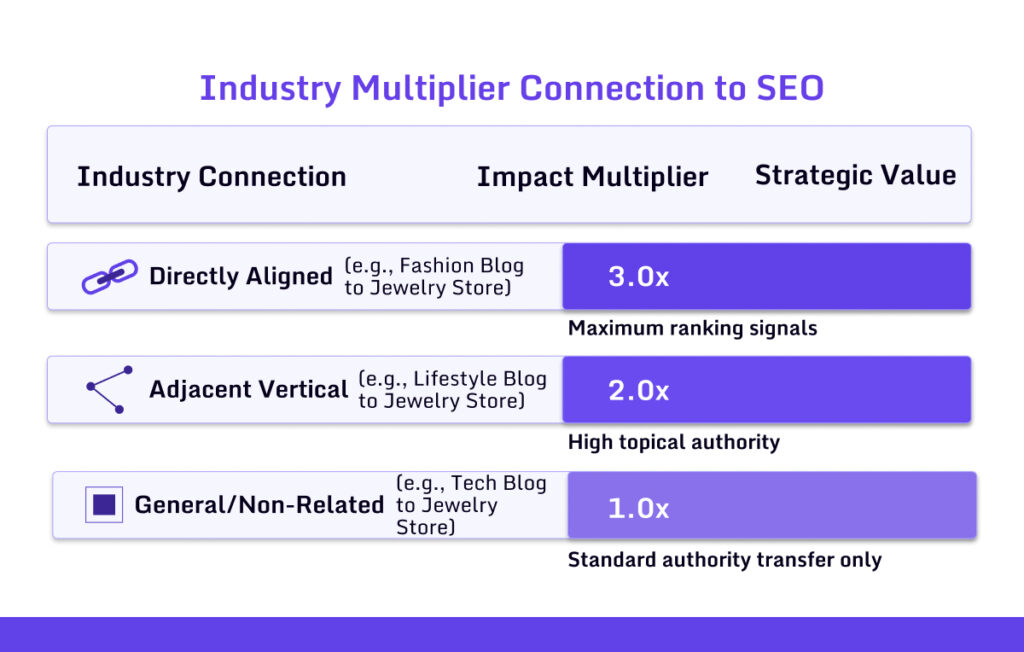
In my experience, the authority of a site (DR) is only the “base” power; the Industry Alignment acts as the multiplier that determines the actual SEO payoff.
The “Context” Case Study
Our moissanite jewelry client benefited massively from this principle. Links from DR 70-90 fashion and lifestyle publications delivered dramatically better results than higher-DR sites in unrelated niches.
Why? Because search engines prioritize the “neighborhood” of the link over raw metrics.
For our Los Angeles tree service client, links from local news blogs, neighborhood magazines, and home improvement guides (DR 50-80) moved the needle more than generic high-DR placements.
Rule of Thumb: A DR 60 link from a directly relevant industry site delivers roughly 3x the SEO impact of a DR 60 link from an unrelated general blog.
Key Takeaway: Industry relevance is your secret multiplier. Always prioritize links from sites that share your topical space over higher-DR irrelevant sites.
The Link Location Power Scale
Where a link resides on a page dictates its “Link Juice” flow. Here is how different placements rank in terms of efficiency.
| Link Placement | SEO Value (% of Full Potential) | Best Use Case |
|---|---|---|
| Editorial In-Content Link | 100% | Contextual citations, expert quotes, source references within the article body |
| Author Bio Link | 50% | Following high-quality guest posts |
| Resource List / Curated Roundup | 40% | “Best tools,” “Top resources” compilations |
| Sidebar Widget | 20% | Peripheral positioning, less contextual relevance |
| Footer Link | 10% | Sitewide but minimal weight |
| Blog Comment Signature | 5% | Least strategically valuable (when dofollow) |
Link placement dramatically impacts SEO value, with contextual positioning serving as the primary determinant of authority transfer.
Editorial in-content links embedded within relevant article text deliver 100% of their potential value, particularly when citing sources or quoting experts, while author bio links following high-quality guest posts retain approximately 50% effectiveness.
Rule of Thumb: One in-content editorial link is worth approximately 10 footer links or 20 blog comment links in terms of ranking impact.
Key Takeaway: Chase editorial in-content links above all else. They deliver maximum authority transfer and look most natural to Google’s algorithm.
When Quantity Actually Matters
Okay, but sometimes you DO need volume. Here’s when:
1. Breaking into Competitive Niches
If everyone has quality, quantity becomes the differentiator.
Example: Our Socialplug client in the digital services market competed against established platforms with years of authority. Top competitors had massive backlink profiles. We needed volume AND quality to compete for 2,500+ backlinks over 24 months, with average DR 60+.
2. New Site Trying to Catch Up
Older sites have years of accumulated links. New sites need acceleration.
Example: Our moissanite jewelry client started at DR 11, competing against established brands. We built 3,000+ backlinks in 16 months—a mix of DR 70-90 authority placements, DR 50-70 contextual mentions, and foundational support links. This volume was necessary to close the authority gap quickly.
3. Local SEO Dominance
Volume of local citations often wins in local search when quality is roughly equal.
Example: Our Los Angeles tree service client built 120+ backlinks in 12 months, combining local authority links (DR 50-80), niche-relevant placements, and high-DR authority links (DR 70-90). This volume helped them dominate the local pack.
4. Building a Diverse Anchor Text Profile
You need volume to make anchor text look natural. Can’t build 100 links with the same anchor text, that’s a penalty waiting to happen.
Key Takeaway: Quantity matters when you’re competing against established sites with both quality AND volume, or when you need anchor text diversity. Otherwise, quality wins.
How Many Backlinks Per Month Is Actually Safe?
At this point, a natural follow-up question is: “Okay, so how fast can I safely build links without freaking Google out?”
The honest answer is that there is no universally safe number per day or per month—what looks natural for a massive e-commerce brand will look completely unnatural for a three-month-old local site.
Instead of chasing a magic daily limit, think in terms of natural link velocity for your size and niche.
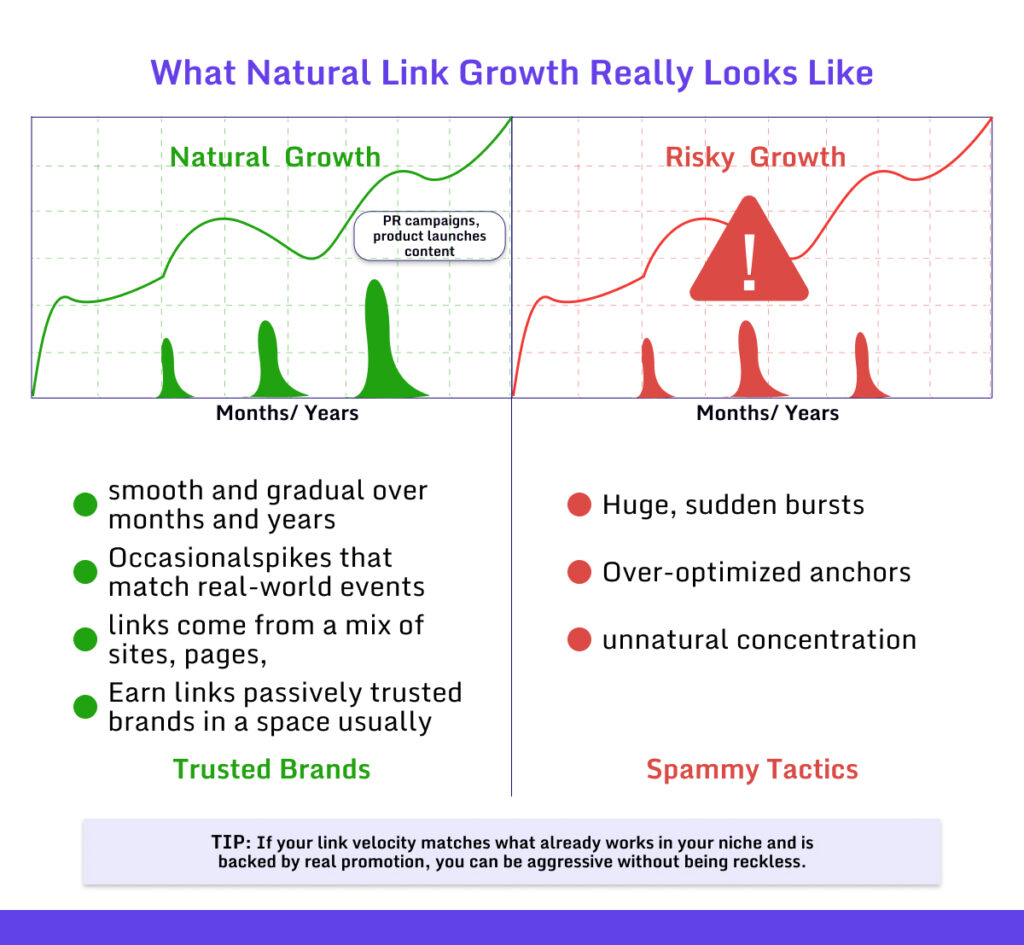
What Natural Link Growth Really Looks Like
When you study the link graphs of stable, successful sites in tools like Ahrefs or Semrush, certain patterns emerge repeatedly:
- ➜ Growth is generally smooth and gradual over months and years, with occasional spikes that match real-world events like PR campaigns, product launches, or viral content
- ➜ New links come from a mix of sites, pages, and anchors; no single source or anchor text dominates the profile
- ➜ The biggest, most trusted brands in a space usually earn links passively as they become the default resource in their niche
In contrast, what do risky profiles have in common?
- ➜ Huge, sudden bursts of low-quality links with no real-world explanation
- ➜ Over-optimized anchors repeated again and again
- ➜ An unnatural concentration of links from the same type of site (e.g., only web 2.0s, only comment spam, only low-quality directories)
If your link velocity matches what already works in your niche and is backed by real promotion, you can be aggressive without being reckless.
If you want to validate whether your backlink velocity, anchor distribution, and referring domains look natural, this link building checklist breaks down the exact pre-scaling checks to run before increasing link volume.
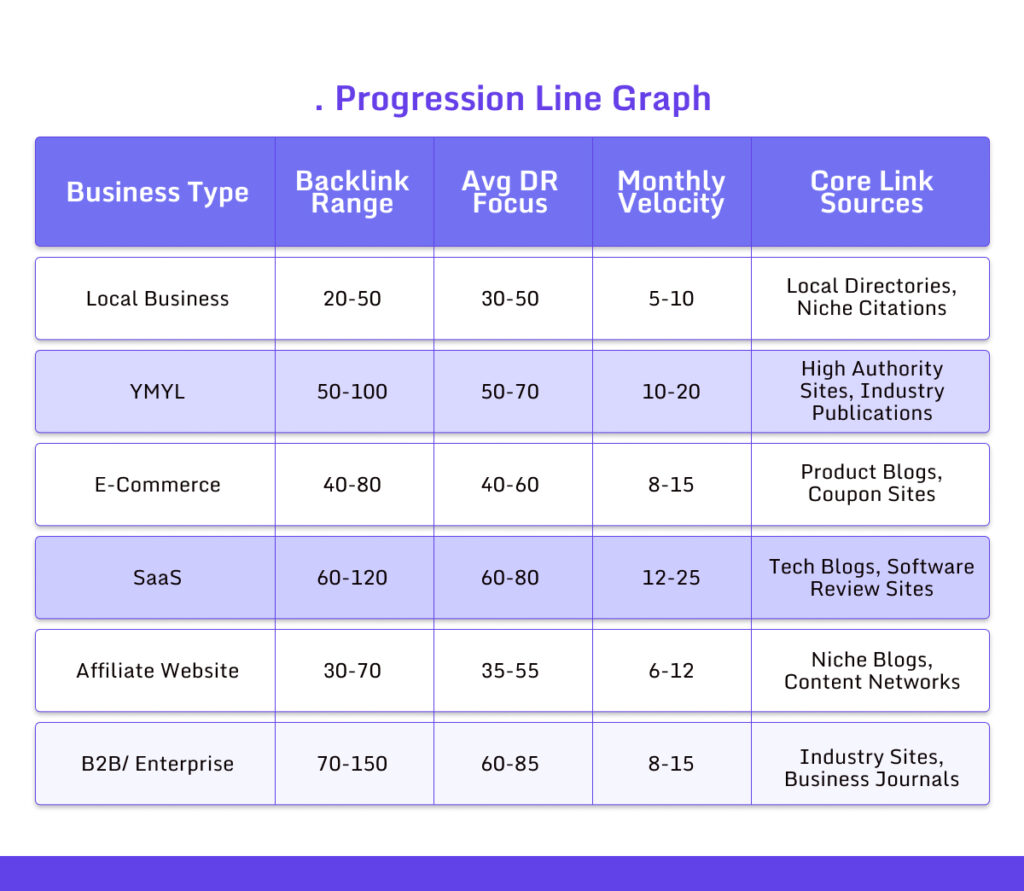
Reasonable Monthly Ranges by Site Type
To give you a starting point, here are practical ranges that tend to look natural in most SERPs when links are high-quality and genuinely earned.
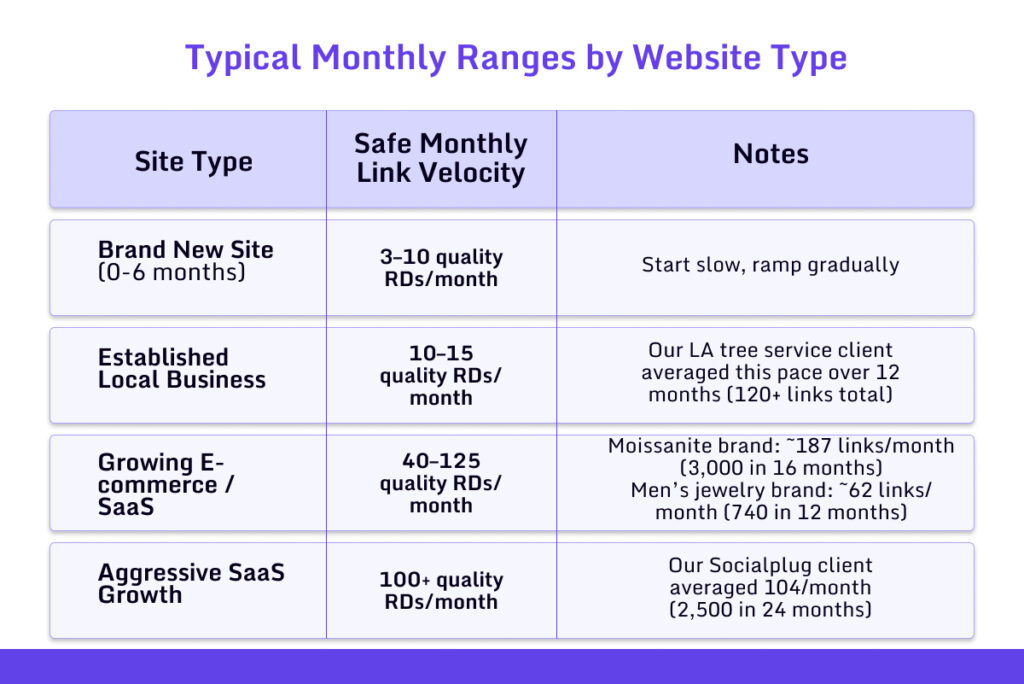
Important: These ranges assume high-quality, genuinely earned links. Link velocity should scale naturally with your site’s age, authority, and promotional activity. The key is that these numbers describe quality referring domains, not random spammy mentions.
Key Takeaway: Match your link velocity to successful competitors in your niche. Going 2-3x faster than the norm with low-quality links is a red flag; matching their pace with higher-quality links is strategic.
Exact Steps to Find Your Own Number
Rather than blindly copying generic ranges, you can calibrate your link velocity by looking directly at the winners in your SERP.
Step-by-Step Competitor Benchmarking:
1. In Ahrefs/Semrush, plug in the top 3–5 ranking sites for your main keywords.
2. Check their “Referring Domains” and filter by date (last 3–6 months).
3. Note how many new referring domains they are gaining each month, not total backlinks, but unique domains.
4. Make sure the links you see are at least decent quality (sites with real traffic, relevant topics, and normal-looking link profiles).
If the leaders in your vertical are gaining 20 new solid referring domains per month, aiming for 10-25/month with similar or better relevance will usually keep you in a safe competitive range.
If they are only picking up 2-5 new domains per month, trying to force 100 new links every month from mediocre sites is a red flag, not an advantage.
Key Takeaway: Your competitors’ link profiles are your roadmap. Study them, match their quality, and aim to exceed their relevance.
Real-World Scenarios: Putting the Numbers Together
Scenario 1: Local Service Business in a Competitive City
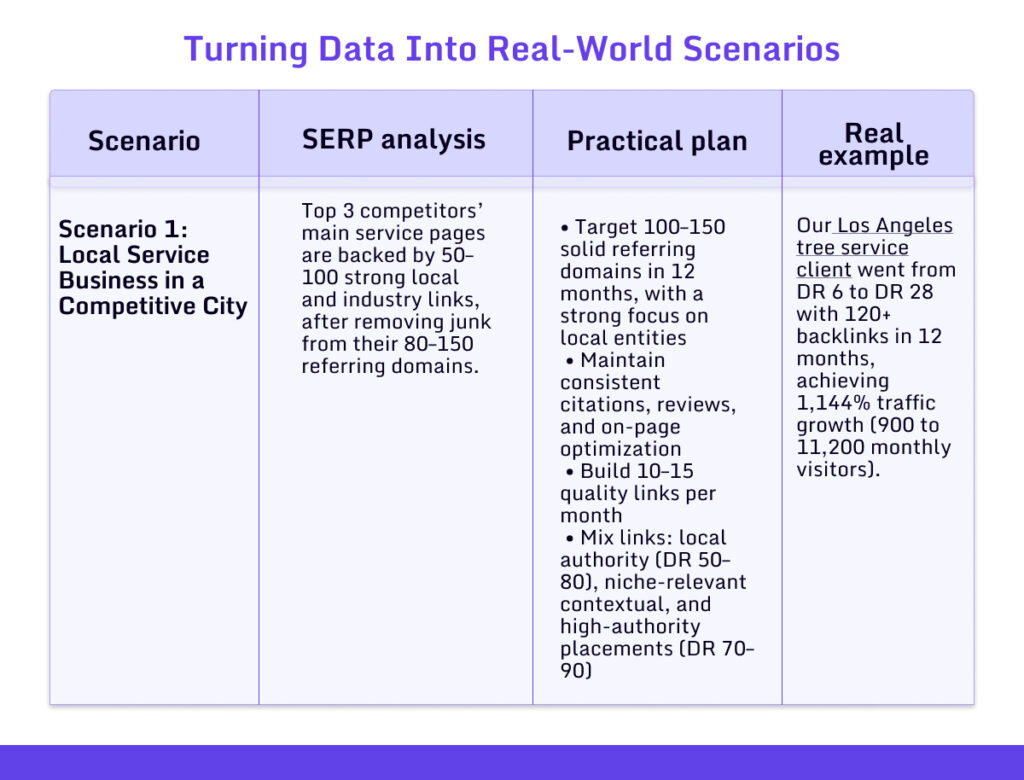
Real example: Our Los Angeles tree service client went from DR 6 to DR 28 with 120+ backlinks in 12 months, achieving 1,144% traffic growth (900 to 11,200 monthly visitors).
Scenario 2: E-commerce Store in Competitive Niche
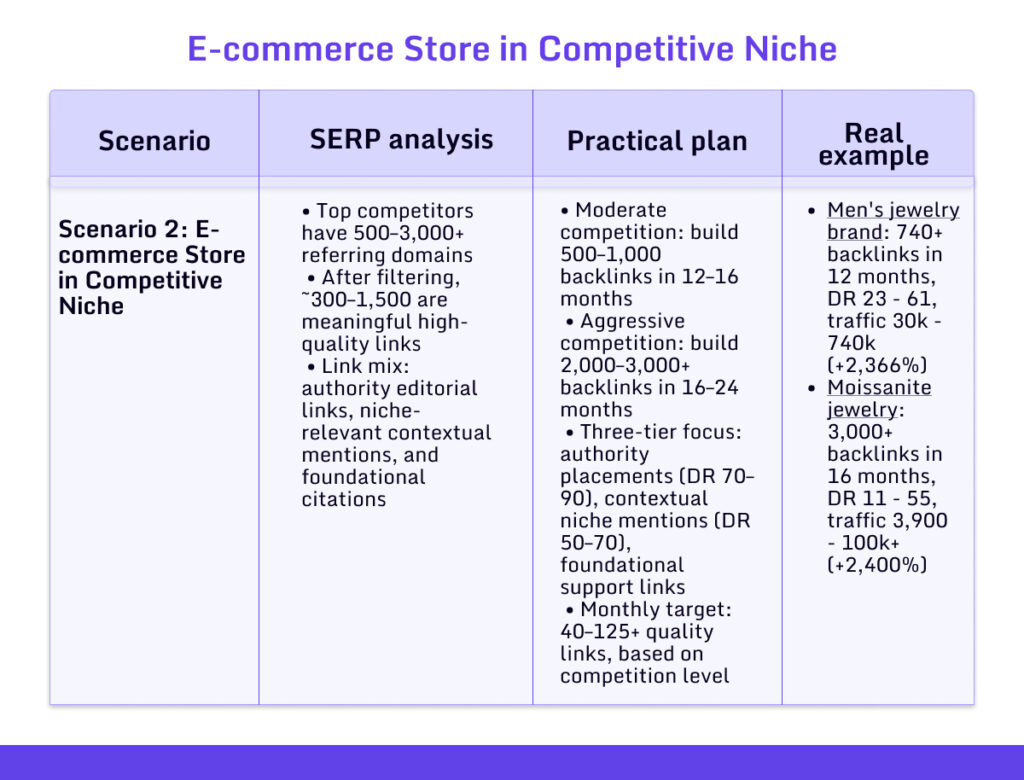
Real examples:
- ➜ Men’s jewelry brand: 740+ backlinks in 12 months, DR 23 – 61, traffic 30k – 740k (+2,366%)
- ➜ Moissanite jewelry: 3,000+ backlinks in 16 months, DR 11 – 55, traffic 3,900 – 100k+ (+2,400%)
Scenario 3: SaaS Company in Competitive Market
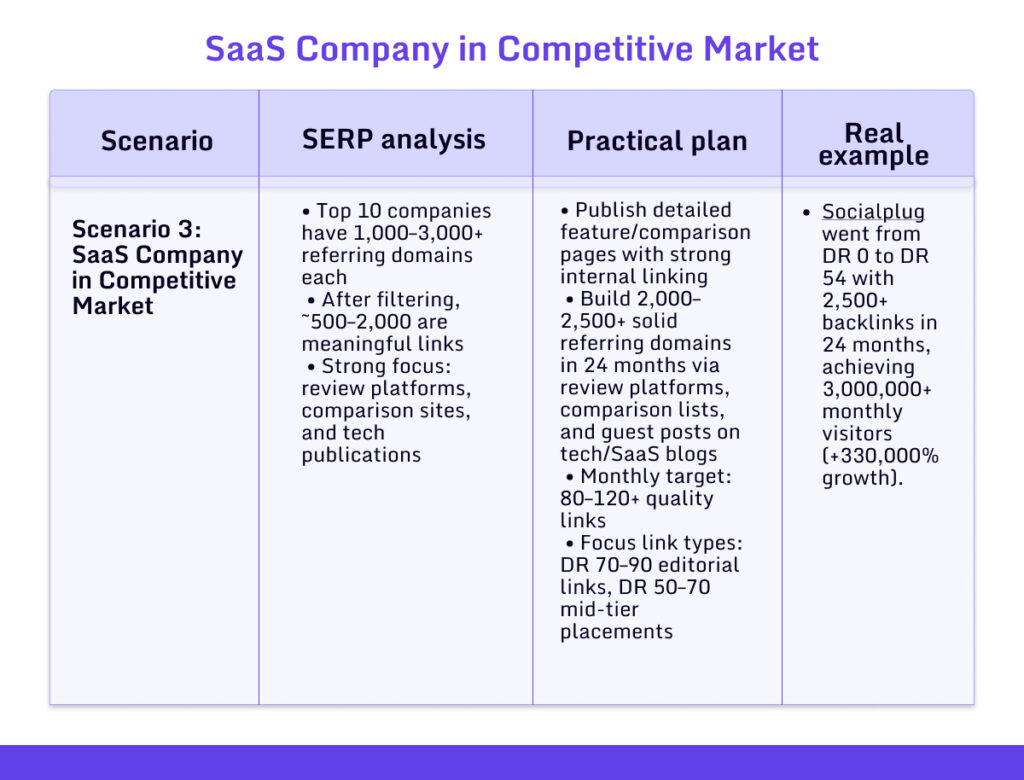
Real example: Socialplug went from DR 0 to DR 54 with 2,500+ backlinks in 24 months, achieving 3,000,000+ monthly visitors (+330,000% growth).
Key Takeaway: Tailor your link-building strategy to your specific competitive landscape. Cookie-cutter approaches fail; custom analysis wins.
How We Help Clients Win With Strategic Link Building
Over the past 10+ years, I’ve refined a systematic approach that consistently gets clients from page 2 (or worse) to the top 3 positions without chasing vanity metrics or wasting budgets on low-quality links.
Our Process:
1. Deep Competitor Analysis: We analyze your top 5-10 competitors’ backlink profiles, filtering out junk to identify the 20-50 links that actually move the needle.
2. Strategic Link Targets: We identify high-authority, high-relevance sites in your industry, the kind that deliver 3.0x relevance multipliers and DR 70+ authority.
3. Custom Outreach Campaigns: We execute targeted outreach using Linkscope’s marketplace with 100,000+ pre-vetted publishers to secure editorial in-content links (100% value) from publications, industry blogs, and resource pages that matter.
4. Safe Velocity Management: We build at a pace that matches your niche’s natural growth patterns, avoiding penalties while staying competitive.
5. Ongoing Monitoring: We track rankings, backlink health, and competitor movements to adjust strategy in real-time.
Our track record speaks for itself:
- ➜ Got Socialplug to 3M+ monthly visitors with 2,500+ strategic links (DR 0 to 54)
- ➜ Helped moissanite jewelry brand reach 100k+ monthly visitors with 3,000+ backlinks (DR 11 to 55)
- ➜ Moved men’s jewelry brand from 30k to 740k monthly traffic with 740+ backlinks (DR 23 to 61)
- ➜ Helped LA tree service dominate local pack with 120+ strategic links (DR 6 to 28, traffic +1,144%)
- ➜ Generated 20k traffic in 7 days from one strategic parasite SEO placement
If you’re tired of generic advice and want a data-driven link-building strategy tailored to your competitive landscape, let’s talk.Schedule a Free Backlink Analysis
Backlink Strategy FAQs: How Many Backlinks Do You Really Need
How many backlinks do you need to rank #1 on Google?
There is no fixed number. The number of backlinks needed to rank #1 depends on your niche, competitor link profiles, and link quality. In low-competition niches, a few high-authority editorial links can be enough. In competitive SERPs, ranking pages typically earn dozens of relevant, strategically placed links—not hundreds of low-quality ones.
Are high-quality backlinks better than hundreds of low-quality links?
Yes. One high-authority, contextually placed editorial backlink can outweigh 50–100 low-quality links. Google evaluates relevance, authority, and placement—not raw link volume—making quality links far more effective in competitive rankings.
Can aggressive link building still work in 2026?
Yes—but only when it’s strategic. Aggressive link building works when link velocity matches competitor benchmarks, anchors remain diverse, and links come from authoritative, relevant sources. Chasing volume without context is increasingly ineffective and risky in 2026.
Final Thoughts: The 2026 Link Building Mindset
The SEO industry is littered with outdated advice telling you to “build 100 links” or “get 500 backlinks” without any context. That approach worked in 2015. In 2026, it’s a recipe for wasted budgets and stagnant rankings.
If you’re planning for long-term SEO growth, understanding the future of link building is critical—because what works today will continue evolving with every major algorithm update.
Here’s what actually works:
✅ Quality over quantity (one DR 90+ link can move rankings faster than 100 junk links)
✅ Relevance as a multiplier (industry alignment delivers 3x impact)
✅ Strategic placement (editorial in-content links deliver 100% value)
✅ Appropriate velocity (match competitor pace with better quality, our clients averaged 10-187 links/month depending on niche)
✅ Competitor benchmarking (custom analysis beats cookie-cutter strategies)
The sites winning in 2026 aren’t chasing link counts. They’re chasing link authority, topical relevance, and strategic placement.
They’re building backlink profiles that look natural, deliver real SEO power, and stand the test of algorithm updates.
Stop asking “how many backlinks do I need?”
Start asking “which backlinks will move the needle for MY specific competitive landscape?”
That’s the question winners ask. And now you know how to answer it. Want help building a backlink strategy that actually works?
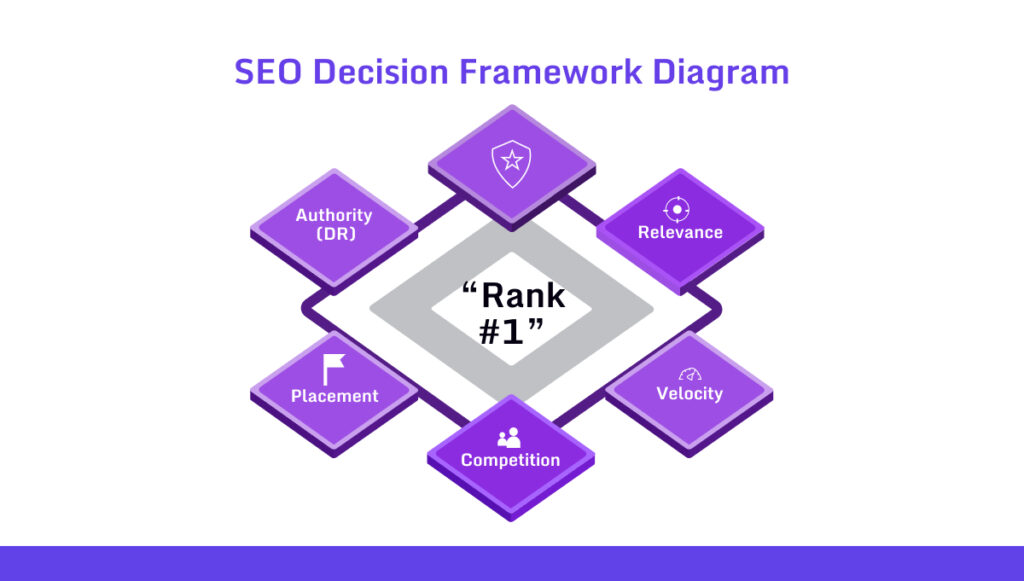
Our verified case studies prove we know how to get results across different industries and competition levels. From local businesses to enterprise SaaS, we’ve cracked the code on strategic link building that delivers measurable ROI.