If you work in SEO, either for your own site or for clients, you’ve probably wondered, “How many backlinks do I need to rank higher?”
I’ve worked in SEO for over a decade and run a link building marketplace.
From experience, I can say there’s no fixed number. The right amount depends on competition, keyword difficulty, and the pages already ranking.
Today, I’ll show you a simple way to calculate how many backlinks you really need to beat your competitors.
How to Calculate Exactly How Many Backlinks YOU Need (Step-by-Step)
First of all, conduct niche and keyword research. Then, also calculate your competitors’ backlink profile. Both will assist you in setting an average monthly backlink requirement goal.
Follow these steps to measure the estimated backlink amount:
Step 1: Identify Your Top 3 SERP Competitors
Firstly, search for your exact target keyword. Ignore big brands if you’re a small site. Now, choose pages with similar search intent and domain authority scores.
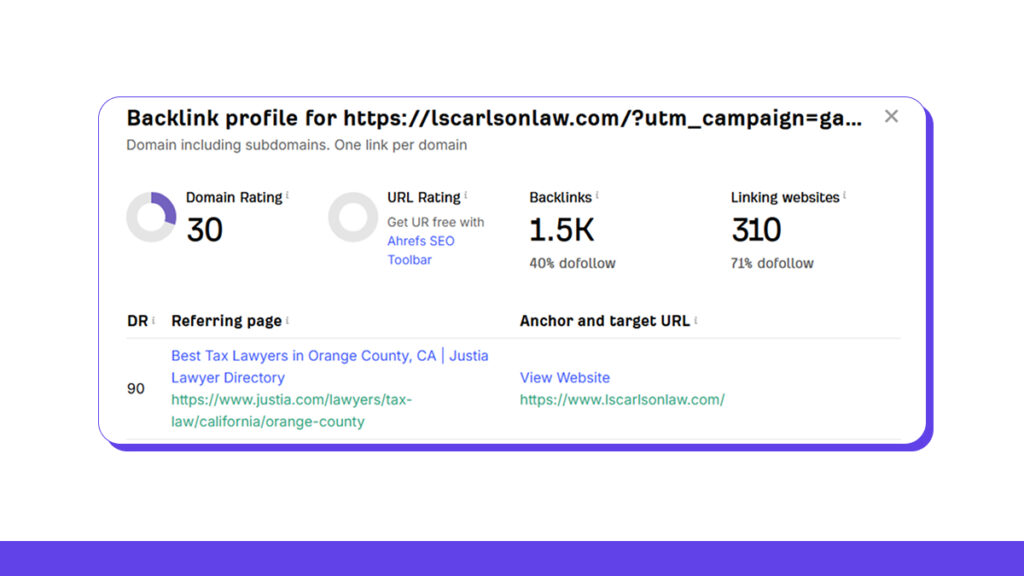
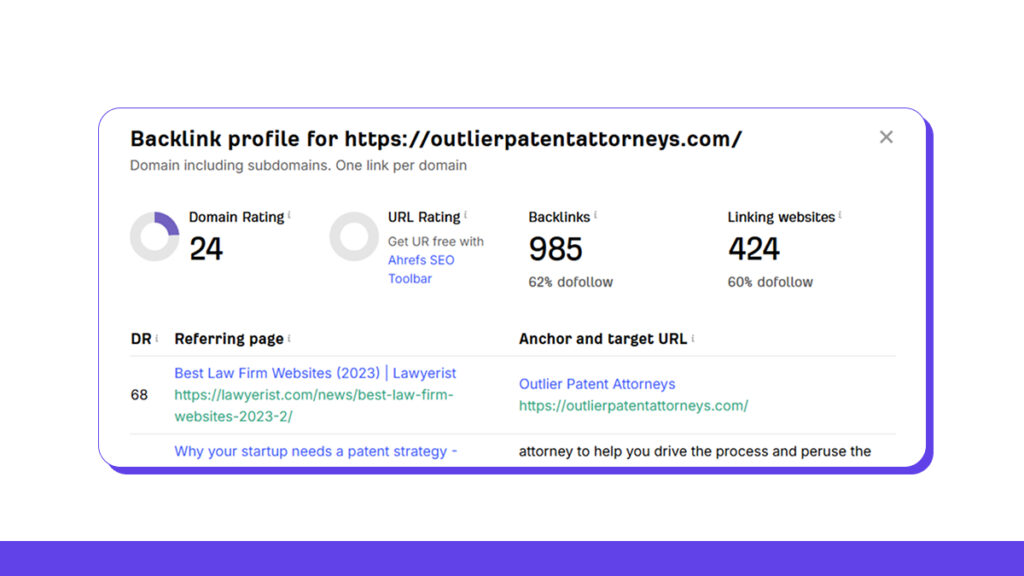
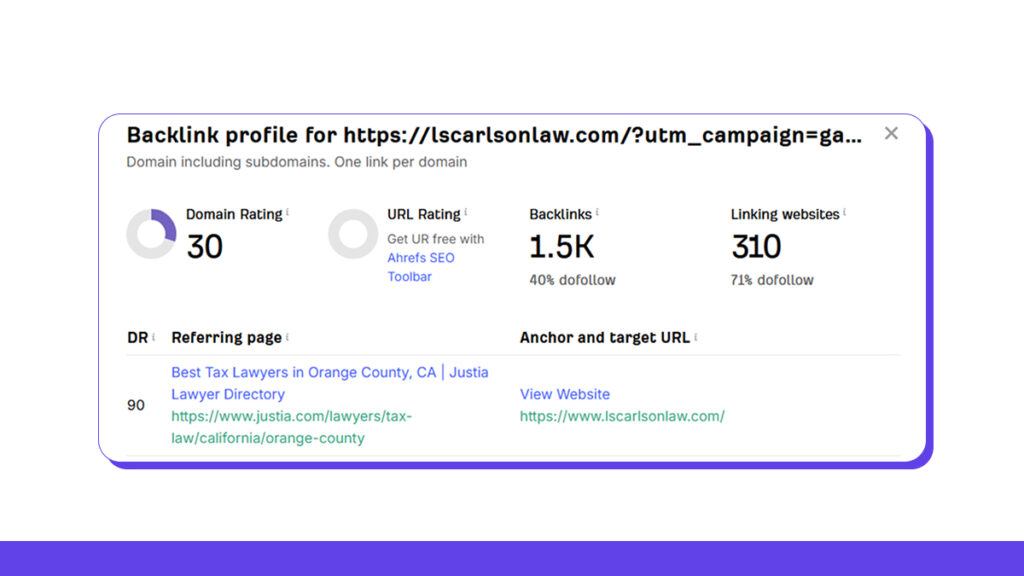
For example, if your main keyword is “Law firm in California”, check the first 3 top websites. Here is a sample image:
Step 2: Analyze Referring Domains (Not Just Total Links)
Count unique referring domains. If your competitor has one site linking 50 times, that’s still 1 referring domain. Together, they create a strong bond, assisting your site to achieve a higher SEO score.
Here, for the keyword we mentioned above, the average number of unique referring domains is 644. Means you need to manage at least 660-700 unique links.
Step 3: Measure Link Quality (DR, Relevance, Placement)
Evaluate competitor links by:
- ➜ Domain Rating (DR)
- ➜ Page relevance
- ➜ DoFollow vs NoFollow
- ➜ In-content vs footer/sidebar
Step 4: Apply the 80/20 Backlink Rule
Don’t get swept away by volume competition. Instead, focus on value-driven links. Apply the Pareto rule, focus your effort on acquiring 10 high-quality links (editorial, listicle, guest posts). Having 1 of them often outperforms 100 weaker backlinks.
The 5 Key Factors That Decide How Many Backlinks You Need
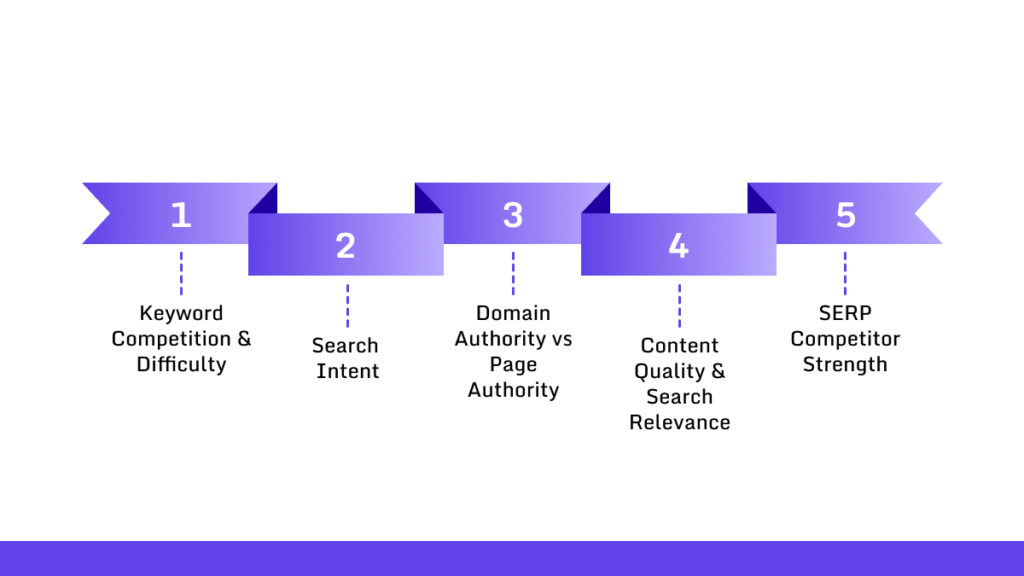
Check out these 5 most impactful website SEO factors among your contestants:
Keyword Competition & Difficulty
20 backlinks are often sufficient for a low-competition keyword. For global keywords with a great difficulty score, the requirement may be doubled.
Search Intent
Commercial queries, such as product pages, are hard to earn links for. Informational queries require fewer backlinks if the content covers the complete search intent.
Domain Authority vs Page Authority
You need to employ aggressive page ranking methods for a new website or one with low DA. For a website with a strong domain authority (70-80+), as few as 10 strong backlinks are enough.
Content Quality & Search Relevance
Backlinko’s previous statistics showed that high-quality content attracts more visitors easily. Moreover, if your content can satisfy readers, it signals good engagement. This also helps you to get an upper hand with a minimal backlink collection.
SERP Competitor Strength
Research the top 3 or 5 competitors’ keyword difficulty ratios. If they are long-trusted websites, your backlink methods will have to surpass theirs. If the authority gap is massive, you should optimize accordingly.
Quality vs Quantity — Which Matters More for Backlinks?
In SEO, backlinking is all about establishing trust through quality mentions. The more quality mentions and links you have, the better. To prevent spamming penalties, please follow a combined backlink approach.
How Many High Quality Backlinks Are Worth 100 Low-Quality Ones?
The simple answer is: only one. A mention from “The Washington Post” will save you the time required to search 100 average-quality backlinks.
Note: Don’t purchase 200 cheap backlinks for $3. Stay active on elite forums, provide editors with your insight, and earn a quality mention.
Do Nofollow Backlinks Count?
Yes. Though they don’t pass the link juice, they indirectly promote your influence. Google’s algorithm often judges it as spamming if your website is full of do-follow links.
Anchor Text Ratios & Natural Link Profiles
We know an exact match is a holy grail. In reality, more than 5% of exact matches are counted as negative or manipulated actions.
Your anchor texts should abide by a versatile hierarchy as follows:
- ➜ Branded Anchors (50%+): Your Site Name (For example: Linkscope).
- ➜ Naked URLs (20%): https://yoursite.com. (For example: https://linkscope.io/)
- ➜ Generic/LSI (25%): “Backlinks,” “our case study,” or descriptive phrases.
- ➜ Exact Match (<5%): Your target keyword.
Our professional link building package follows these exact anchor text ratios to ensure every campaign looks natural and penalty safe.
How Many Backlinks Do Different Types of Pages Need?
A page-specific approach will help you to design your strategy, minimizing your room to work Even experts, like Jonathan Boshoff, work in the same way.
Blog Posts
They are your authority builders. To rank log tail queries, 5-10 quality referrals are enough.
Homepage
To maintain a brand standard, at least 50-100 backlinks establish a strong foundation. More competitive keywords will require a higher quality backlink ratio and versatile sourcing.
Product & Service Pages
These are the hardest pages to earn links due to the heavily transitional query. Include them in a listicle or helpful guide to gain generic backlinks.
Local SEO Pages
Managing 10-20 links from your local shops is enough for these pages. Even one local business authority link is enough instead of 10 links.
Backlink Strategies to Reach Your Target Faster
Stop wasting your time on an outdated mass outreach strategy. Your link-building approach should cover topical relevance and editorial integrity. This will automatically take you further than your challengers.
Editorial & Niche Links
Earning trust in industry-specific forums or publications is the gold standard. Google recognizes you as a reliable one to display for user queries.
Guest Posts vs Link Insertions
Renowned platforms, such as Ahrefs, recommend publishing audience-focused posts. They will earn backlinks naturally. Niche edits keep your best content active. This allows your existing high-performing content to keep supporting.
Digital PR and mentions
Utilizing platforms, such as HARO, empowers you to build a strong authority within your niche. Readers will see you as a trusted expert. This approach will encourage them to visit more, leading to a natural traffic boost.
So, How Many Backlinks Do You Really Need?
Just follow the simple rule- quality if you are running for a difficult keyword. You need more high-quality backlinks than the pages currently ranking above you. At level pegging, 5-10% more high-quality backlinks will be a game-changing element.
If your goal is to improve your page score, focus on gathering continuous links from diverse sources.
Or take help from Linkscope. We can do it better!
FAQ
How many backlinks should I have?
For a basic standard home page, 50-100 good-quality, keyword-supporting backlinks are considered enough. Analyze your competitor’s approach for that certain keyword or niche. Make sure you have a higher-quality backlink ratio than they do.
How many backlinks are needed to increase PageRank?
Set your bar as your page is designed for. Aim for managing 20-50 quality backlinks per month for a targeted page.
Is 75 a good SEO score?
No. Your on-page score should be at least 90. Lower scores mean a bad user experience. For off-page, your domain authority must be 40 or higher. If your domain authority is 75, it shows a very strong off-page profile.
How many links per 1000 words?
To establish a good SEO score, keep a good balance between external and internal links:
External: At least 2-5 links per 1000 words.
Internal: Include 3-8 relevant page links per 1000 words
What is the 80/20 rule in SEO?
The 80/20 rule simply suggests finding out highly effective SEO tasks. For example, if you need 20 backlinks, managing one HARO backlink is worth 100 low DA website backlinks.
What is a toxic link in SEO?
These Low-quality backlinks violate Google’s spam policy:
➜ Comment spamming,
➜ Irrelevant links,
➜ Low-quality, less-trusted website links
➜ Overly action-driven anchor texts
They are referred to as toxic backlinks, gradually dragging down your SEO score.